

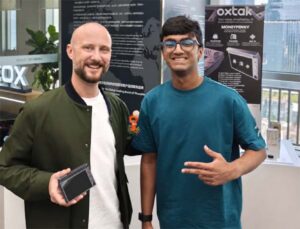
The 20-year-old founding team member and Chief Hardware Officer is overseeing the development and manufacturing of Persona Band, a screenless AI wearable scheduled to begin shipping in December 2026.
HYDERABAD, India — October,21,2026 — Persona, a startup developing a screenless, voice-enabled wristband designed to bring personal AI into everyday life, is preparing to take its wearable from engineering to production ahead of planned December shipments. At the centre of that effort is Hyderabad’s Aarav Garg, the 20-year-old founding team member and Chief Hardware Officer overseeing the device’s product development and manufacturing as the company works to bring conversational AI to the wrist.
Garg leads Persona’s hardware engineering, product development and manufacturing programme, working with manufacturing partners in China to take Persona Band from design and engineering towards production. The company is preparing to begin shipments in December 2026.
We are currently testing sample production runs to assess build quality and refine the overall product experience. Our goal is to deliver a premium experience across both hardware and software—from the materials and finish to unboxing, setup and everyday use.
“We’ve radically simplified the design so that switching straps—and even putting the Band on or taking it off—feels effortless. But making those interactions so simple has required a distinctive design and engineering approach, which has introduced manufacturing challenges that conventional strap designs don’t face. Taking that from prototype to production has been a mountain of learning: understanding how each material, mechanism and assembly process behaves, then working through the challenges one by one,” said Garg, founding team member and Chief Hardware Officer at Persona.
Persona Band is designed to bring a voice-enabled personal assistant into everyday activities without requiring users to interact with a screen. Weighing 27 grams, the device incorporates two microphones, a speaker and a 12-LED ring that communicates its operating status. Persona says the band is designed to deliver up to five days of battery life and support more than 120 languages.
The engineering challenge is to bring these components together in a compact device while balancing battery performance, voice interaction, reliability and comfort.
“One of our toughest constraints has been fitting a speaker, a dual-microphone array and a battery designed to last three to five days into one of the smallest wearable form factors. That combination has pushed us to rethink almost every aspect of the internal design and develop custom components, including a battery tailored to the space available.
“We initially planned to leave the speaker out of V1 because of the space and power constraints. But we realised that the experience would feel incomplete if users could speak to the Band and then had to turn to their phone for a response. Adding a speaker closes that interaction loop on the device itself and reduces dependence on the phone. We decided that experience was worth the additional engineering and manufacturing complexity, even though it made the product considerably harder to build,” said Garg.
The device is intended to work alongside Persona’s AI assistant, which can help users manage appointments, emails, notes and travel through natural conversation. The assistant is currently available in a free beta through iMessage, while the wearable is being prepared for launch.
Moving from a working prototype to a product ready for customers introduces a different set of requirements, including manufacturing consistency, quality control, supplier coordination and production costs.
Garg works directly with Persona’s manufacturing partners in China as the company prepares the band for production.
“We’re currently carrying out sample production runs. The design has been validated, and our focus now is on testing those units rigorously to identify and resolve any remaining failure points before the first mass-production run.
“One of the biggest challenges has been waterproofing such a compact device while maintaining consistent build quality. Our testing includes submerging units in a water tank to check for water ingress and pressing the button 10,000 times to assess its durability. These checks are part of making sure the design holds up in practice and that the units we manufacture consistently meet our quality standards before we approve mass production,” said Garg.
“Over the next 12 months, we’ll iterate quickly on the Band and keep improving both the technology and the product. We’re also building an intelligence layer that can power the products we develop next. The Band is only the beginning: we already have additional hardware form factors planned internally, and we intend to keep expanding what we build around that intelligence,” said Garg.
Garg’s experience in hardware development predates Persona. He began building robots as a child, later studied at Purdue University and subsequently co-founded Omi, another AI wearable startup. He is now applying that experience to Persona, where his responsibilities span hardware development and the manufacturing process.
Persona is developing its wearable as part of a broader effort to make personal AI available through a dedicated device rather than relying solely on a smartphone interface.
The company’s next milestone is the planned December 2026 shipment of Persona Band. Preorders are available at US$179.
Persona has raised US$10 million in a funding round led by Vine Ventures, with participation from Cory Levy and Collective Global, at a reported valuation of US$100 million. The company plans to use the funding to support its product and business development as it prepares for launch.