

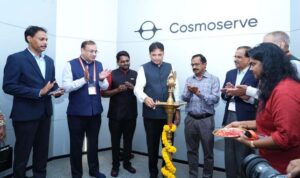
- D. Sridhar Babu, Minister for Information Technology, Electronics & Communications, Industries & Commerce, and Legislative Affairs, Government of Telangana Inaugurated Base 1, India’s first end to end facility focused on in orbit servicing, space sustainability and extending the life of satellites. This facility will strengthen India’s capabilities in satellite servicing and space debris removal.
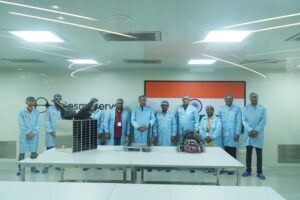
Hyderabad, India, 05 November 2026 – Cosmoserve Space today unveiled Base 1, India’s first private and the world’s sixth facility equipped with space vision effect and microgravity simulation. The facility brings full-stack space servicing capabilities under one roof. Today, the facility was inaugurated by Union Minister Dr. Jitendra Singh, Minister of State (Independent Charge) for Science & Technology and Earth Sciences, Department of Space and Shri D. Sridhar Babu, Minister for Information Technology, Electronics & Communications, Industries & Commerce, and Legislative Affairs, Government of Telangana, in the presence of Dr. Chiranjeevi Phanindra, Founder & CEO of Cosmoserve Space, Sai Krishna, IT Advisor, Government of Telangana, and other space industry leaders. They toured the facility, visiting the satellite integration clean room, robotics lab and mission simulation centre, and witnessed live demonstrations of robotic capture systems and microgravity simulation technology.
Base 1 brings together the infrastructure needed to design, build, test and operate various functionalities required for satellite servicing and space debris recovery. It houses four key facilities: an Orbital Rendezvous and Capture Lab to simulate spacecraft capture operations; a Space Robotics Innovation Lab to develop robotic capture systems; an ISO Class 8 clean room for satellite integration; and a Mission Simulation and Control Centre to manage upcoming missions. Beyond removing space debris, the facility will support satellite servicing, including in-orbit repairs and refuelling. Cosmoserve currently sources close to 60% of its mission components locally. The company aims to develop more critical technologies in-house through Base 1 and strengthen domestic manufacturing capabilities. This will help reduce dependence on imported components such as optics, avionics and space-grade electronics.
Union Minister, Dr. Jitendra Singh, said “I congratulate Dr Chiranjeevi and his team on the inauguration of Cosmoserve Space’s Base 1 facility. This marks an important milestone in India’s private space sector. By bringing together space robotics, rendezvous and capture testing, satellite integration and mission control under one roof, Cosmoserve Space’s Base 1 facility demonstrates the growing capabilities of India’s space startups.”
D. Sridhar Babu, Minister for Information Technology, Electronics & Communications, Industries & Commerce, and Legislative Affairs, Government of Telangana, said, “Facilities like Cosmoserve’s Base 1 show exactly why Hyderabad is leading the country in space innovation. We are now home to over 30 spacetech companies, including India’s first spacetech unicorn and few more soonicorns. They are building everything from launch vehicles and space data centres to debris removal systems and drug discovery platforms. This level of deep-tech execution is possible because we have the fastest growing aerospace and defence sector in Hyderabad alongside 52 national labs, a talent pool of 1.5 million engineers, and a local supply chain that covers nearly 90% of their component needs. Hyderabad is ready to lead the world as the most affordable space tech hub. To support these visionaries and keep this momentum going, our government is actively planning an exclusive Space City within the upcoming Bharat Future City.”
Dr Chiranjeevi Phanindra, Founder & CEO of Cosmoserve Space, said, “In our first year we have flown our first payload on an Indian rocket, raised our seed round, and today we open a facility where we can design, build, test and fly our missions under one roof. Debris is becoming the limiting factor for every nation’s space ambitions, including India’s. Base 1 is where we build the capability to keep orbits usable, for Gaganyaan, the Bharatiya Antariksh Station and every satellite that follows.”
The facility follows Cosmoserve’s $6 million seed funding round, taking its total funding to over $9 million. Japan-based Rebright Partners joined Indian investors Aranya Holdings, Naandi Ventures, and existing investors AUM Ventures and Shakti VC in the round. In July 2026, Cosmoserve flew its first payload, Mission Embrace, aboard Skyroot Aerospace’s Vikram-1 rocket. The flight hardware was developed in under four months, six months ahead of schedule. Although the robotic capture petals did not deploy as planned, the mission provided valuable data for further development. Cosmoserve was also among 30 startups selected to showcase its technology to French President Emmanuel Macron in the presence of Prime Minister Narendra Modi. The funding will support Base 1, technology demonstrations and two upcoming missions.
Space debris is one of the biggest challenges facing the global space industry. Of the approximately 28,000 satellites in orbit, nearly 10,000 are dead or non-operational. Beyond these inactive satellites, Earth’s orbit is crowded with an estimated 68,000 debris objects smaller than 10 cm, 1.5 million fragments measuring 1–2 cm, and nearly 230 million tiny pieces ranging from 1 mm to 1 cm. Even fragments just a few millimetres wide can pose serious risks to operational satellites, spacecraft and missions such as the International Space Station (ISS), given the high speeds at which they travel. Around 660 collisions and explosions have been recorded in space, generating nearly 58,000 tracked debris fragments. As orbital congestion increases, so does the demand for space debris removal and satellite servicing, with the global market projected to reach $14.5 billion by 2030.
To address this, Cosmoserve has developed a proprietary Dual Spacecraft Architecture, moving beyond the conventional one-to-one recovery model, where a dedicated spacecraft services a single satellite, to a more cost-efficient two-to-many approach. Under this model, a larger Orbital Service Station acts as an in-space logistics hub carrying fuel, equipment and spare parts, while a smaller Autonomous Service Vehicle travels to multiple satellites to capture, dock with, diagnose, repair or remove them from orbit. The architecture is designed to enable just two spacecraft to service multiple satellites, potentially bringing servicing costs down from around $10 million to below $1 million per satellite. By developing these capabilities in Hyderabad, Cosmoserve aims to make orbital servicing more affordable through local manufacturing and engineering.
“Space debris is a shared global problem, and the best solutions will come from teams like Cosmoserve who combine deep technical pedigree with the urgency to move fast. Rebright is excited to be a part of this mission,” said Takeshi Ebihara, Founding General Partner at Rebright Partners, the Tokyo-based venture capital firm making its first spacetech investment in Cosmoserve.
Cosmoserve’s upcoming milestones include testing its robotic capture systems in microgravity flights, reflying Mission Embrace and conducting a full-scale space debris capture demonstration in 2027. “Active Debris Removal and in-orbit servicing will become increasingly important as activity in space continues to grow. At AUM, we believe some of India’s most important DeepTech companies will emerge by solving challenges that are global in nature, and Cosmoserve is a strong example of this,” said Chetan Mehta, Managing Partner at AUM Ventures. “We are pleased to deepen our investment and support Cosmoserve as it works towards making debris removal and in-orbit servicing a commercially deployable capability.”
“Cosmoserve is making rapid strides at turning science fiction into reality. Garbage removal is a ubiquitous and frequent use case both on earth and in space. Chiran and team are heralding a promising start to the next decade of space commerce,” added Keval Desai, Managing Partner at Shakti VC.
Hyderabad’s strong aerospace and defence ecosystem, skilled engineering talent and research capabilities make it a growing hub for India’s spacetech industry. Cosmoserve’s Base 1 adds to this ecosystem by bringing advanced infrastructure for space robotics, satellite servicing and debris removal, further strengthening Hyderabad’s position in the global space industry.