

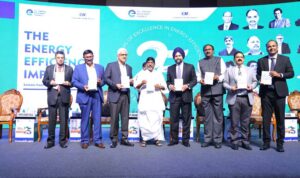
Hyderabad, India, 16 September 2026: The Confederation of Indian Industry (CII) on Day 1 of the 25th Energy Efficiency Summit 2026 brought together policymakers, industry leaders, technology providers and sustainability experts at the Hyderabad International Convention Centre (HICC), Hyderabad, to deliberate on accelerating India’s transition towards a Net Zero economy. Organized by the CII – Green Business Centre, the Summit was held under the theme “Accelerating the transition to a Net Zero economy through energy efficiency, clean technologies, and sustainable practices.”
The inaugural day also featured the 22nd Power Plant Summit 2026 and the 20th PaperTech 2026, creating a comprehensive industry platform focused on energy efficiency, clean technologies, industrial decarbonisation, resource conservation, digitalisation and sustainable manufacturing. While the Power Plant Summit examined the future of thermal power through efficiency, sustainability, flexibility and Artificial Intelligence, PaperTech 2026 focused on making the Indian pulp and paper industry world class through technology, innovation, sustainability and operational excellence.
Addressing the inaugural session, Mallu Bhatti Vikramarka, Deputy Chief Minister, Government of Telangana, emphasized the role of energy efficiency and clean technologies in enabling sustainable economic growth. He said, “Energy efficiency is not merely an environmental obligation; it is an economic competitiveness strategy. For a rapidly growing state like Telangana, the answer is not to slow down economic activity, but to make every unit of energy support more economic activity. The cheapest unit of electricity is often the unit we do not need to consume. Energy efficiency is, in many ways, a power plant that requires no new land, no coal mine and no new transmission line. Every megawatt of demand permanently avoided through efficient motors, better cooling systems, intelligent buildings, smart industrial processes and digital energy management reduces pressure on the entire electricity system while lowering operating costs and emissions. As we look ahead, the challenge is to measure what matters, share solutions that work and scale proven technologies from one plant to hundreds of enterprises. Telangana wants its growth to be rapid, but also intelligent – producing more, prospering more and wasting less. That is good economics, good energy policy and, ultimately, the most practical path towards sustainability.”
Mr. Tejpreet Singh Chopra, Chairman, Energy Efficiency Summit 2026 and Founder & CEO, BLP-Industry.AI, highlighted the convergence of technology, efficiency and industrial innovation. He said, “Energy efficiency is often called the ‘first fuel.’ It brings down demand, cuts costs, and creates room for cleaner sources of power to grow faster. I do believe AI and digital tools are becoming a catalyst for everything this Summit stands for. They compress the time between identifying an efficiency opportunity and acting on it. And they allow institutions like CII-Green Business Centre to scale their impact – moving from conducting a few hundred audits a year, to continuously monitoring thousands of assets across the country.”
Mr. Ajay Sharma, Chairman, Power Plant Summit 2026 & Executive Director (Operation Services), National Thermal Power Corporation Ltd. said, “India’s energy transition cannot be measured only by how many megawatts of capacity we add; it must also be measured by how efficiently we operate, how effectively we integrate renewable energy and how much value we create from every megawatt of capacity. As we move towards a net-zero economy, we cannot immediately do away with thermal power; we must make it more efficient, flexible and responsive while accelerating the integration of renewables and energy storage. The future of India’s energy system will be built on efficient thermal power, renewable energy, storage and digital intelligence.”
Mr. Ganesh Bhadti, Chairman, PaperTech 2026 and Executive Director (Operations and Projects), Seshasayee Paper & Boards Limited, said, “Energy efficiency and decarbonisation are the two wings that will determine the future and sustainability of industry. The Indian paper industry has demonstrated that it can benchmark itself against global standards, and its inherent characteristics—renewability, recyclability and biodegradability—give it a strong foundation to pursue a net-zero future. What we do today to advance energy efficiency, and decarbonisation will determine the sustainability of our industry tomorrow.”
The Inaugural session was also attended by Mr. Goutham Reddy, Chairman, CII Telangana and Executive Vice Chairman, Re Sustainability Ltd.; Mr. Y. Harish Chandra Prasad, Past Chairman, CII AP & Chairman, Mahalaxmi Group; Mr. C Shekar Reddy, National Chairman, CII Indian Green Building Council (IGBC) & & Managing Director, CSR Estates Ltd; Mr. KS Venkatagiri, Executive Director, CII Green Business Centre; and Mr. P V Kiran Ananth, Executive Director – Energy Efficiency, Renewable Energy and Green Entrepreneurship, CII Green Business Centre.
The inaugural session witnessed the release of three publications — The Energy Efficiency Imperative: Lessons from the Past, Leadership for the Future, capturing key lessons and future priorities in India’s energy-efficiency journey; the CII Thermal Power Plant Benchmarking Report 2026, establishing performance benchmarks and identifying opportunities to enhance efficiency and resource utilization; and Best Practice Manual in Paper Sector – Volume 14, showcasing 11 replicable best practices for energy and resource efficiency from India and international paper-sector leaders.
The inaugural session highlighted that India’s transition towards Net Zero will require technology-led energy efficiency, operational excellence, modernization, AI-enabled decision-making, resource conservation, renewable energy and circularity, supported by collaboration across industry ecosystems. The discussions emphasized the need to translate sustainability ambitions into practical and scalable solutions that can strengthen industrial competitiveness, enhance energy security and improve environmental performance. The day also marked the first day of the 27th edition of the CII National Award for Excellence in Energy Management, with 263 industries across 15+ sectors sharing their best practices, innovative technologies and approaches to energy efficiency—continuing CII’s long-standing effort to recognize and promote excellence in energy management across industry.
The event witnessed participation from 1600+ policymakers, senior industry leaders, technology providers, researchers, academia, energy professionals, startups, and other key stakeholders, with 60+ national and international speakers contributing to the deliberations. The event also featured a large exposition showcasing 75+ innovative technologies and solutions, highlighting emerging opportunities for energy efficiency, clean technology and sustainable growth.