

Asia-Pacific’s (APAC) corporate market capitalization rankings underwent a sharp reshuffle in the third quarter of 2026, with artificial intelligence (AI) infrastructure emerging as the dominant force behind the region’s biggest valuation gains. Taiwan Semiconductor Manufacturing Co (TSMC) retained the top spot, but the more striking shift was the surge in memory and semiconductor names, while Chinese banks and energy companies gained ground. At the same time, several former technology leaders, including Tencent, Alibaba and Contemporary Amperex Technology, lost substantial ground from a year earlier, according to GlobalData, a leading intelligence and productivity platform.
TSMC ended September with a $2.02 trillion market capitalization, up 2.8% from the June quarter and 81.6% from a year earlier. Its lead reflects sustained demand for advanced AI processors, particularly at the three-nanometer and two-nanometer nodes and for Chip-on-Wafer-on-Substrate (CoWoS) advanced packaging. TSMC reported record second-quarter profit, with net income rising 77% year over year, while management described AI demand as a strong, multiyear structural trend.
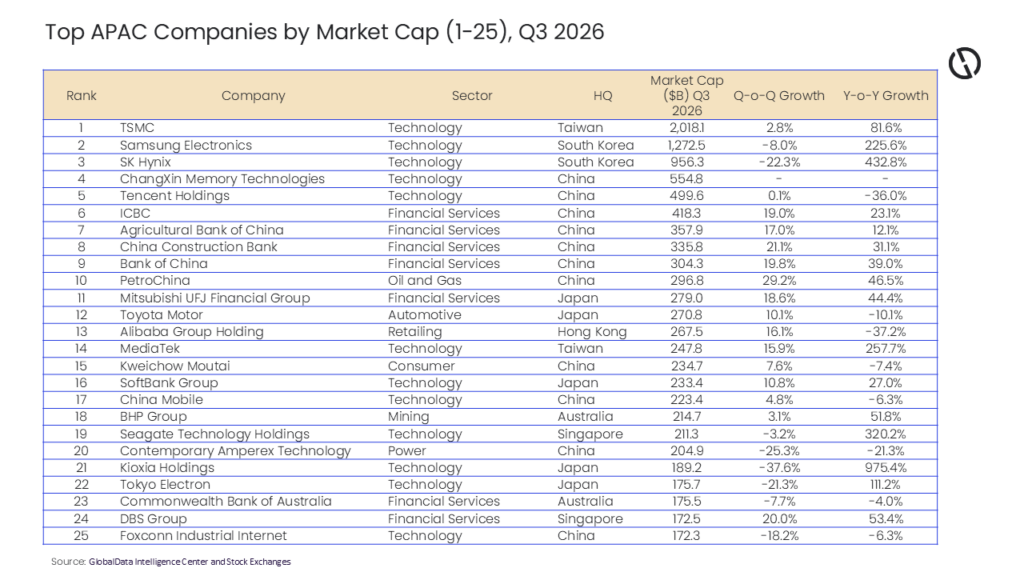
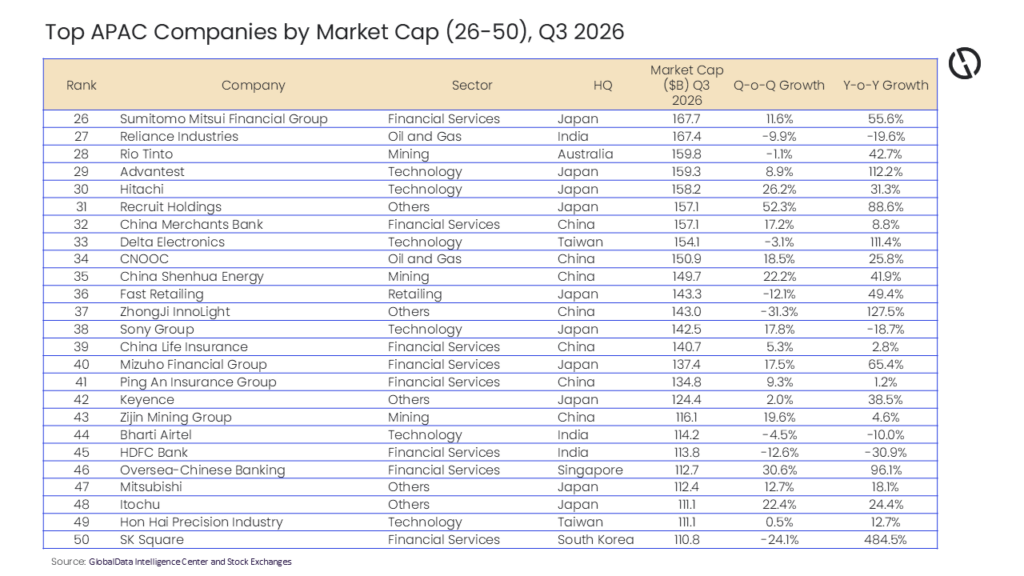
Murthy Grandhi, Company Profiles Analyst at GlobalData, comments: “The market capitalization of the 50 largest APAC companies was $13.74 trillion at the end of Q3, up 4.7% from the end of June and 49.5% on a year ago. But $555 billion of the quarter’s $620 billion gain came from one newcomer: ChangXin Memory Technologies (CXMT), which listed in Shanghai in July. Without it, the group rose just 0.5%, with 33 companies gaining and 16 declining.”
South Korea’s semiconductor complex produced the most dramatic year-on-year gains. Samsung Electronics reached $1.27 trillion, up 225.6%, while SK Hynix reached $956.3 billion, up 432.8%. SK Hynix’s record second-quarter results were driven by high-value DRAM and HBM demand, with HBM4 entering mass shipments and the company’s long-term agreements with key customers. Samsung is also benefiting from the memory upcycle and expanding HBM4 sales, although its shares corrected 25% from their June peak by early October as investors questioned whether memory margins had peaked.
The semiconductor boom extended beyond the traditional giants. ChangXin Memory Technologies, valued at $554.8 billion, entered the ranking in fourth place, while MediaTek surged 257.7% year over year to $247.8 billion. Seagate gained 320.2% to $211.3 billion, reflecting the storage requirements created by AI and hyperscale data centers. Seagate’s fiscal 2026 revenue increased by 34%, while management cited robust cloud data-center demand and durable storage requirements from AI-generated data.
China’s financial sector provided a separate source of market cap growth. ICBC rose 19% quarter over quarter to $418.3 billion, while Agricultural Bank of China, China Construction Bank, and Bank of China gained 17%, 21.1%, and 19.8%, respectively. The gains came despite weak credit demand and prolonged pressure from China’s property slowdown and low interest rates, suggesting investors are increasingly differentiating the large state-owned lenders from smaller, more vulnerable institutions.
Energy also strengthened. PetroChina climbed 29.2% from the end of June to $296.8 billion, while CNOOC rose 18.5%. The moves came as geopolitical tensions pushed oil prices sharply higher during the quarter; Brent rose about 40% in Q3 amid disruptions linked to the Middle East conflict.
Grandhi adds: “Not every large-cap technology name benefited. Tencent fell 36% year over year and Alibaba 37.2%, while CATL declined 21.3%. Japan’s Kioxia was an extreme outlier: its market cap rose nearly tenfold year over year, before falling 37.6% from June, highlighting the extraordinary volatility accompanying the memory cycle. Meanwhile, Japan’s banks gained strongly, with MUFG up 44.4% year over year, SMFG 55.6% and Mizuho 65.4%, as higher Japanese interest rates improved the sector’s earnings backdrop.”
Recruit (+52.3%) lifted its full-year operating profit target 20% as Indeed’s AI-driven monetization eased disruption fears. India went the other way. Reliance (-9.9%), HDFC Bank (-12.6%) and Bharti Airtel (-4.5%) fell as foreign investors sold, the rupee neared 96 per dollar and oil rose.
Grandhi concludes: “Looking ahead, GlobalData anticipates that the AI infrastructure will continue to reshape APAC’s market-cap hierarchy, from foundries and HBM to storage and equipment, but elevated valuations leave the theme exposed to rates, energy costs, geopolitics, and capital intensity. Q4 hinges on HBM pricing at TSMC, Samsung, and SK Hynix; Brent prices and any Hormuz agreement; and the impact of tighter US financial conditions on Asian technology and Hong Kong equities. CXMT is the key risk, given its thin float, 6.5x re-rating, and potential US blacklist exposure. TSMC appears the most resilient large holding, supported by its lack of memory exposure.”