

Procurement Leaders Risk Job Chaos Without Proactive Strategy
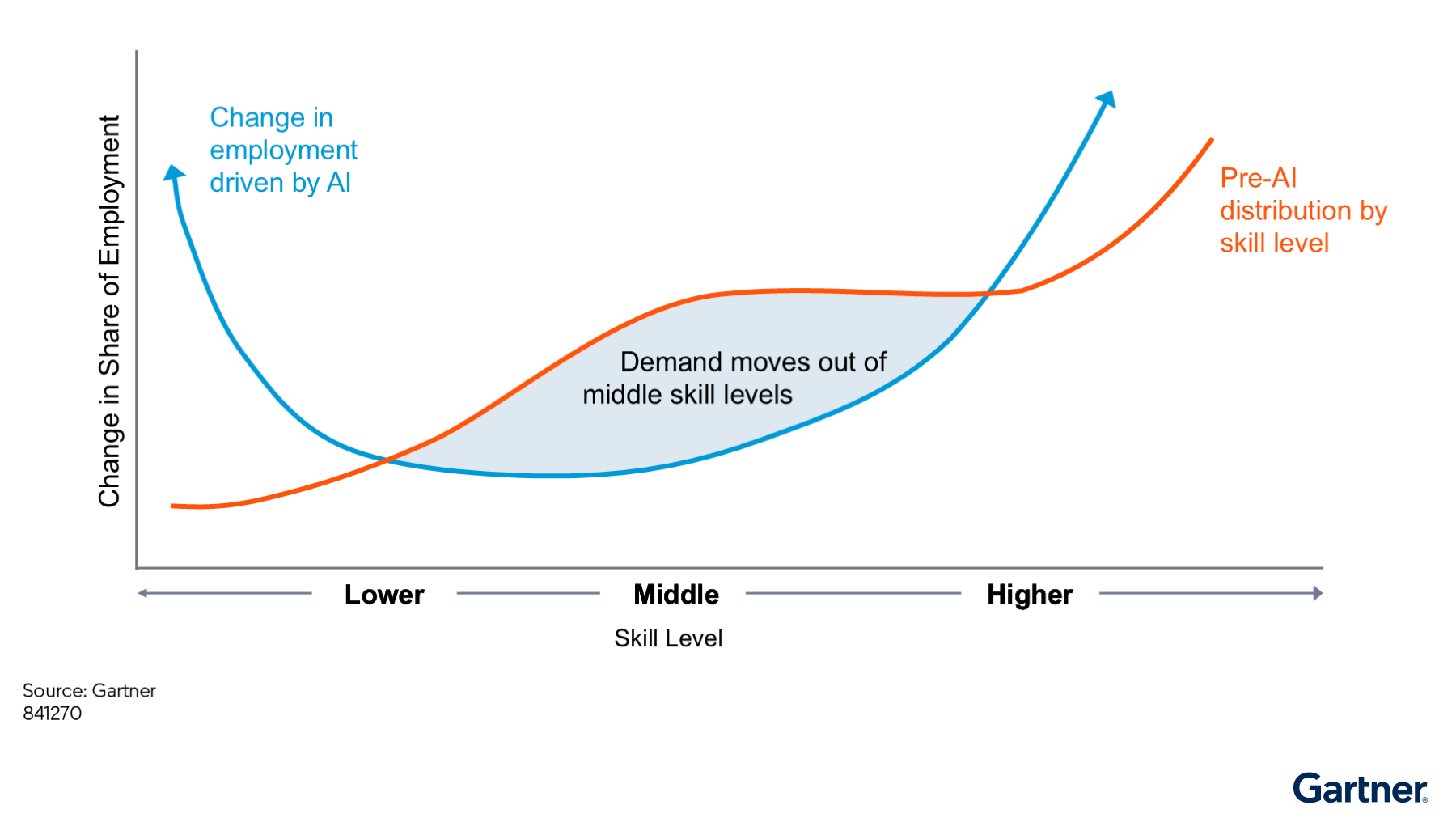
The disconnect puts procurement functions at risk of “job chaos,” as AI hollows out standardized, middle-skilled work while reshaping responsibilities, workflows and required skills across the function. Organizations that fail to proactively redesign roles risk talent mismatches, reduced employee morale and diminished competitiveness (see Figure 1).
“Successful AI implementation at the functional level is fundamentally a role redesign challenge,” said Fareen Mehrzai, Senior Director Analyst in Gartner’s Supply Chain practice. “Responsibilities and skills across procurement are already changing. Chief procurement officers (CPOs) who delay redesigning roles risk leaving employees without a clear path forward and their organizations without the talent needed to capture the full value from AI.”
Figure 1: AI’s Impact on Employment and Skill Levels
Source: Gartner (October 2026)
Managing the AI Talent Stack
Middle-skilled procurement roles face particular pressure because much of their work is standardized and therefore ripe for AI. Future demand is shifting toward lower-skilled, highly AI-augmented roles and higher-skilled positions requiring creativity and complex problem solving. CPOs should audit roles with employees and determine which responsibilities should remain with people and which should shift to AI.
Action 2: Build Enduring Human Skills
The automation of routine work puts a premium on human capabilities that AI cannot readily replicate, including creativity, influence, agility and ethical judgment. CPOs should regularly assess employees’ technical and human skills and provide targeted development opportunities to strengthen critical capabilities before they erode.
Action 3: Create a Safe Environment for Experimentation
CPOs should create a “workforce sandbox” where employees can safely test AI tools and workflows, continuously learn, and treat failed experiments as part of development. Leaders should be transparent about AI goals, address employee resistance directly and use communities of practice and peer networks to accelerate AI learning and adoption.
“CPOs must give employees agency in shaping how their roles evolve and create an environment where they can build new capabilities through experimentation,” said Mehrzai. “Role redesign cannot be a one-time exercise; it will need continuous adjustment as AI advances and employees learn what works in practice.”