

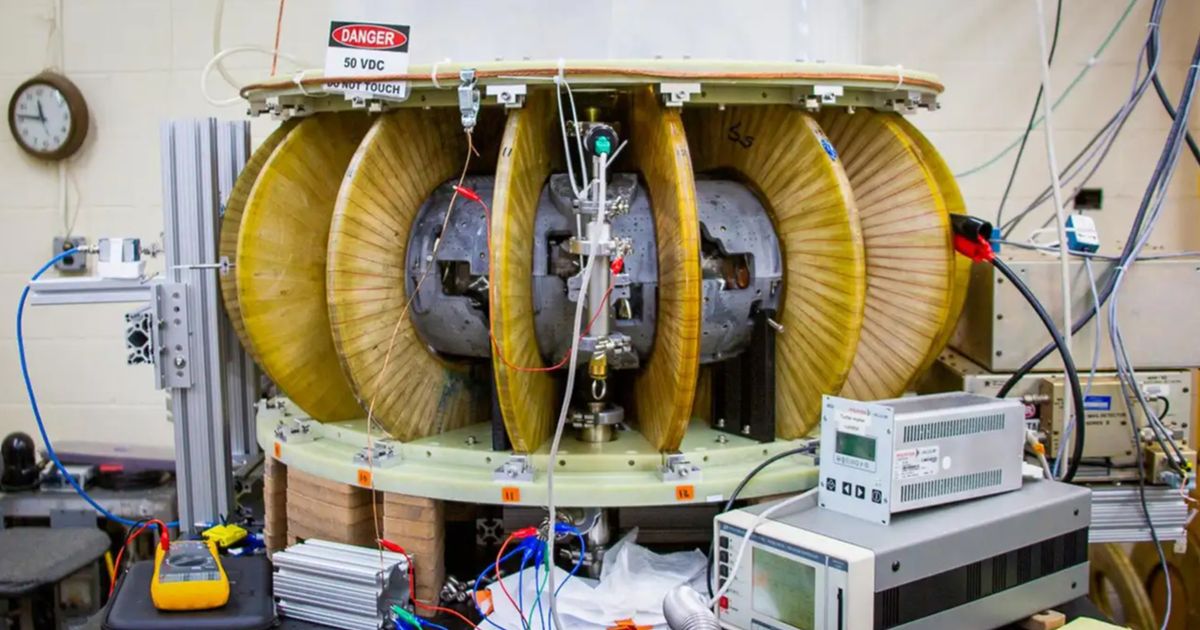
A team of researchers at the Princeton Plasma Physics Laboratory in the US have built what is known as a stellarator, a twisting fusion reactor that uses permanent magnets.
The lab run by the United States Department of Energy built the reactor from 3D-printed and off-the-shelf parts, making for a particularly cost-effective build for their experiment, dubbed MUSE.
What is nuclear fusion?
Nuclear fusion is the reaction that powers our Sun, merging atoms into new molecules and producing incredible amounts of energy in the process.
Commercial nuclear reactors operating today use fission instead of fusion, using the energy generated from splitting atoms rather than fusing them.
Fission produces nuclear waste but is a fairly easy and stable method of producing energy.
Fusion requires a much higher initial energy input to begin the reaction, and to maintain it at a stable and therefore self-sustaining state, but becomes energy positive once that state is achieved.
The challenge thus far has been creating a fusion reaction that creates more energy than it requires, a milestone passed recently by the Department of Energy’s Lawrence Livermore National Laboratory. The LLNL achieved a result of about 2 megajoules in and about 3 megajoules out.
Martin Greenwald, a physicist at MIT’s Plasma Science and Fusion Center and a member of the MIT-CFS collaboration, told Gizmodo in an email that the result is “a mark of the maturity of the field and the validation of the underlying science”.
“While a technical tour de force, the general approach, which this experiment takes, would require extraordinary advances in technology to have utility as an energy source,” Greenwald added. “To many of us, it seems unlikely that it would ever lead to a practical fusion power system. Thus we are pursuing magnetic confinement approaches.”
The Stellarator
There are a swathe of technical issues still to be solved for nuclear fusion to be viable but the Princeton Plasma Physics Laboratory’s research appears to have taken a step in the right direction.
The Stellarator’s cruller-shaped device contains high-temperature plasma, which can be tuned to create the conditions for fusion reactions.
“Using permanent magnets is a completely new way to design stellarators,” said Tony Qian, a graduate student at Princeton Plasma Physics Laboratory and lead author of two papers published in the Journal of Plasma Physics and Nuclear Fusion that describe the design of the MUSE experiment.
“This technique allows us to test new plasma confinement ideas quickly and build new devices easily.”
Permanent magnets like those made from rare earth elements for wind turbines and other future energy applications don’t require electric current to generate their fields and can be purchased off-the-shelf without customisation.
The MUSE experiment used permanent magnets attached to a 3D-printed surface to achieve its fusion reaction.
“I realised that even if they were situated alongside other magnets, rare-earth permanent magnets could generate and maintain the magnetic fields necessary to confine the plasma so fusion reactions can occur,” Michael Zarnstorff, a research scientist at the laboratory and principal investigator of the MUSE project, in a press release.
“That’s the property that makes this technique work.”
While there is still a long way to go before fusion reactors are commercially viable, continued breakthroughs in materials engineering and metallurgy continue to offer new avenues of research for nuclear scientists to pursue.