

Residential Heat Pump Market
Surge in installation of residential heat pumps in homes for maintaining warm and cool temperature drive the growth of the residential heat pump market.
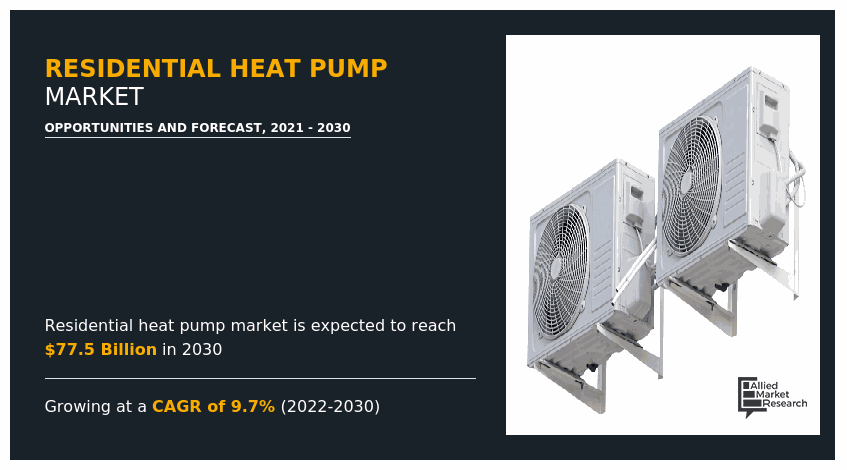
PORTLAND, OREGON, UNITED STATES, October 11, 2022 /EINPresswire.com/ — According to the report published by Allied Market Research, the global residential heat pump market generated $33.5 billion in 2021, and is projected to reach $77.5 billion by 2030, witnessing a CAGR of 9.7% from 2022 to 2030. The report provides a detailed analysis of changing market dynamics, top segments, value chain, key investment pockets, regional scenario, and competitive landscape.
Surge in installation of residential heat pumps in homes for maintaining warm and cool temperature along with adoption of energy and cost efficient systems drive the growth of the residential heat pump market. Moreover, technological advancements are expected to offer lucrative opportunities for the market growth.
Download Report Sample (210 Pages PDF with Insights) @ https://www.alliedmarketresearch.com/request-sample/16351
The global residential heat pump industry is segmented on the basis of type and power source. By type, the market is classified as air source, water source, and geothermal.
Based on power source, the electric powered segment held the largest market share in 2021, holding nearly three-fourths of the total market share, and is expected to continue its leadership status during the forecast period. Moreover, the same segment is projected to register the highest CAGR of 10.1% from 2022 to 2030. The report also analyzes the air powered segment.
Based on region, Asia-Pacific is contributed to the highest share in terms of revenue in 2021, holding more than one-third of the total market share, and is estimated to continue its dominant share by 2031. Moreover, the same region is projected to manifest the fastest CAGR of 10.3% during the forecast period. Other regions analyzed in the report include North America, Europe, and LAMEA.
The key players profiled in this report include Midea Group, Johnson Controls, Daikin, Carrier Corporation, Glen Dimplex, NIBE, Stiebel Eltron, Viessmann, Mitsubishi Electric Corporation, and Danfoss.
Request a Discount Before Purchasing Report @ https://www.alliedmarketresearch.com/purchase-enquiry/16351
IMPACT OF COVID-19 ON THE GLOBAL RESIDENTIAL HEAT PUMP MARKET
• Residential heat pumps are commonly used to warm the interior of homes. However, due to the lockdown and severe controls implemented as a result of the COVID-19 pandemic, heat pump production plants have suffered a significant reduction in 2020, owing to a reduced workforce and a disturbed supply chain.
• COVID-19 hampered different industrial activities and disrupted the supply chain, affecting practically all industries. Due to a lack of workers, most businesses have shut down. As a result of COVID-19’s influence, the global residential heat pump market forecast has seen a significant drop.
• According to the United Nations Industrial Development Organization (UNIDO), 30.0%–70.0% of pre-COVID-19 workforce of various industries, such as electrical and other third-party vendors, migrated to their hometowns due to uncertainties and loss of income during the lockdown. This unavailability or less availability of workforce is expected to directly affect the production and manufacturing activities, thereby resulting in decline in the residential heat pump market growth during the forecast period.
Key Findings of the Study
• On the basis of type, the air source segment dominated the global residential heat pump market in 2021 and is projected to be the fastest-growing segment during the forecast period.
• On the basis of power source, the electric powered segment dominated the global residential heat pump market in 2021 and is also projected to be the fastest-growing segment during the forecast period.
• On the basis of region, Asia-Pacific market is projected to grow fast during the forecast period.
Allied Market Research
Allied Market Research
+ + 1-800-792-5285
email us here
Visit us on social media:
Facebook
Twitter
LinkedIn