

Odin is a general-purpose programming language designed with simplicity, clarity, and performance in mind. Created by Ginger Bill, Odin is positioned as an alternative to C, focusing on modern features while retaining manual memory management and explicit control over data layout. It is widely used in game development, systems programming, and performance-critical applications.
Key Features of Odin
1. Simplicity and Readability
Odin adopts a syntax that is clean, expressive, and avoids unnecessary complexity. Inspired by languages like Pascal, Go, and C, it eliminates boilerplate code while keeping the language easy to read and write.
2. Performance-Oriented Design
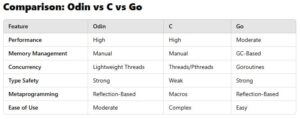
Odin is designed to be as fast as C while improving compilation speed, code maintainability, and safety. It provides manual memory management and low-level optimizations, making it a powerful tool for performance-sensitive applications.
3. Powerful Type System
- Distinct types help prevent errors caused by implicit type conversions.
- Implicit context-based parameters simplify function definitions.
- Tagged unions provide better memory efficiency and safety.
4. Memory Safety and Allocation Control
Unlike higher-level languages that abstract memory management, Odin gives developers explicit control over allocations while offering features like:
- Custom allocators
- Stack-based allocation
- Pointer safety features to minimize errors
5. Built-In Data-Oriented Programming (DOP) Support
Odin strongly supports data-oriented design, making it an excellent choice for game engines and real-time applications. Features like struct-of-arrays (SoA) layout are easier to implement compared to object-oriented paradigms.
6. Metaprogramming Without Macros
Instead of traditional preprocessor macros, Odin has a powerful compile-time reflection system that allows developers to generate efficient code dynamically.
7. Better Concurrency Model
Odin provides lightweight threading and parallel execution capabilities through:
- Thread-safe job systems
- Built-in SIMD (Single Instruction, Multiple Data) support
- No garbage collection, ensuring predictable execution
8. Cross-Platform Compatibility
Odin supports multiple operating systems, including:
- Windows
- Linux
- MacOS
- BSD
It can generate static and dynamic libraries, making it easy to integrate with other languages.
Syntax and Code Examples
Here’s a simple “Hello, World!” program in Odin:
Functions and Type Safety
Odin functions are explicit and type-safe, preventing many common bugs.
Structs and Memory Management
Structs in Odin are lightweight and cache-friendly:
Concurrency and Parallel Execution
Odin allows multi-threaded execution with simple syntax:
Use Cases of Odin
Odin is widely used in:
- Game Development: Due to its performance and data-oriented design.
- Systems Programming: Suitable for operating systems, embedded systems, and compilers.
- High-Performance Computing (HPC): Excellent for scientific computing and simulations.
- Graphics Programming: Ideal for rendering engines and GPU-intensive applications.
Community and Ecosystem
Odin has an active community on Discord, GitHub, and forums. While the ecosystem is still growing, it includes:
- Official compiler and standard library
- Game engine integrations
- Package manager support
How to Get Started with Odin
- Download Odin from the official repository: https://odin-lang.org
- Install Odin Compiler following the setup guide.
- Write and Compile Code using
odin run filename.odin.
Conclusion
Odin is a modern, performance-oriented alternative to C, offering better type safety, data-oriented programming features, and a streamlined syntax. It is particularly useful for game developers, system programmers, and anyone needing high-performance applications.