

Induced Pluripotent Stem Cell (iPSC) Global Market Report 2022 – Market Size, Trends, And Global Forecast 2022-2026
The Business Research Company’s Induced Pluripotent Stem Cell (IPSC) Global Market Report 2022 – Market Size, Trends, And Forecast 2022-2026
LONDON, GREATER LONDON, UK, September 21, 2022 /EINPresswire.com/ — The induced Pluripotent Stem Cell (iPSC) market was largely unaffected by the COVID-19 pandemic, with near double-digit growth maintained throughout the period 2019 to 2021 and beyond. Increasing demand for iPSCs for in vitro drug discovery, toxicology screening, and basic research is supported by pharmaceutical, biotechnology, and academic customers, driving growth over the next five years. Due to the increasing global chronic disease burden, there is a growing need for autologous cell-based and regenerative medicine therapies, which is driving the development of novel therapies based on the promise of iPSCs to provide a rich source of autologous cells, tissues, and organs for clinical applications. However, the hurdles inherent in translating the promise of iPSCs into safe and effective human therapies are substantial, especially regarding the long-term safety of cells with tumorigenic potential. The clinical application of iPSCs will therefore be limited to indications where benefits outweigh potential risks until these technical hurdles are overcome. Nonetheless, research into clinical applications of iPSCs is strongly supported by significant investment by both governments and industry, which is likely to drive future growth of the iPSC market.
Human Embryonic Stem Cells, derived from unused preimplantation blastocysts generated for in vitro fertilization, exhibit unlimited self-renewal in cell culture in the undifferentiated state while retaining the capacity to differentiate into cell derivatives of all three germ layers, essentially giving rise to any cell type in the body for potential therapeutic use. However, their use is limited due to ethical considerations regarding the use of embryo-derived material and the inability to derive such cells from an adult individual, preventing their utilization in a patient-specific manner. These limitations can be overcome with the use of induced pluripotent stem cell (iPSC) technology. This approach allows adult somatic cells (such as fibroblasts or blood cells) to be reprogrammed into pluripotent stem cells by the introduction of a set of transcription factors linked to pluripotency. The resulting iPSCs can then be differentiated into a variety of cell types, such as cardiomyocytes, neuronal cells, hepatocytes, and hematopoietic cells, using in vitro differentiation protocols. Importantly, because the iPSCs can be generated in a patient-specific manner, this technology can be used to develop autologous cell and regenerative therapies that can avoid immunologic rejection. They can also be used to generate patient/disease-specific models of different genetic disorders, to optimize patient-specific therapies, and to establish screens for drug testing and drug discovery.
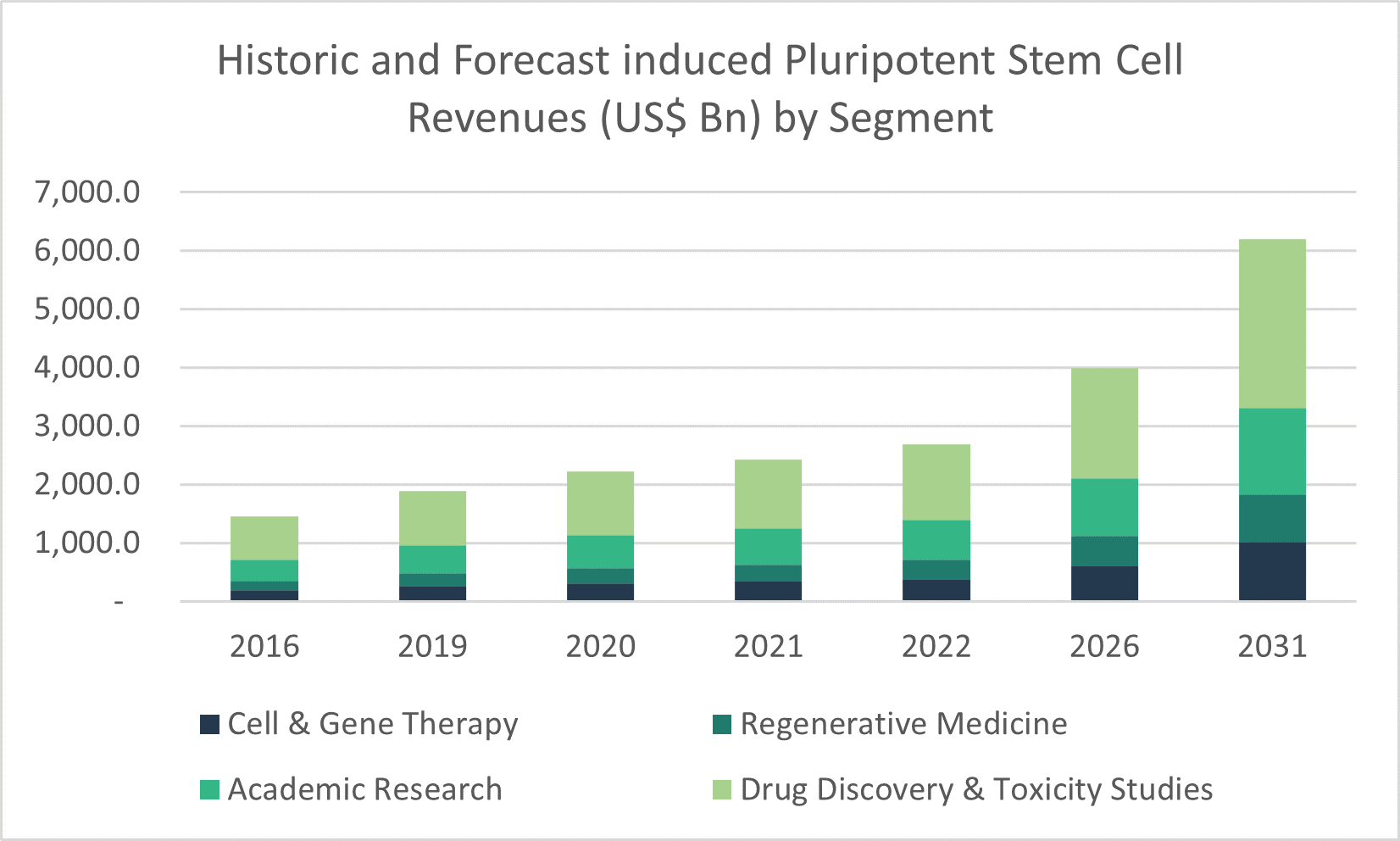
The iPSC market consists of sales of induced pluripotent stem cells and related services. The global iPSC market was largely unaffected by the COVID-19 pandemic. Revenues of $1.89 billion in 2019 increased to $2.22 billion at the height of the pandemic in 2020, and continued to grow at a CAGR of 9.3%, reaching $2.43 billion in 2021. While the broader cell biology market was disrupted by supply chain issues and the reduction in routine patient services, iPSCs were deployed during the pandemic due to ongoing research and development activities.
Pre-clinical drug discovery and toxicity studies represent the largest segment of the market, accounting for 48% ($1.18 billion) of the iPSC revenues in 2021, with academic research accounting for a further 25% of the market ($618 million). Clinical applications of iPSCs accounted for the remainder of the revenues, with cell and gene therapy applications accounting for 14% ($348 million) and regenerative medicine applications accounting for 12% ($288 million). In 2021, North America was the largest region in the global iPSC market, accounting for 49% of the market, followed by Western Europe with a further 38%. Asia-Pacific and Eastern Europe were the third and fourth largest regions, accounting for only 8% and 3% of the global iPSC market, respectively. Africa was the smallest region in the global autoimmune disease diagnostics market. As per data from the Global Market Model, the market is expected to reach $4.00 billion in 2026 at a CAGR of 10.5%, with clinical applications growing slightly faster than preclinical applications (CAGR of 12% versus 10%), reflecting the ongoing development of the iPSC technology and the emergence of novel therapies.
An increase in the prevalence of chronic disorders is one of the major factors that will drive the growth of the iPSC market. According to the Partnership to Fight Chronic Disorders (PFCD), 65% of adults have at least one chronic condition, and 86% of health care spending is associated with people with chronic conditions. Treatment of chronic disorders, such as heart, lung, and kidney disease; cancer; stroke; diabetes; and neurodegeneration, has the potential to be revolutionized by iPSC technology, providing large quantities of autologous differentiated human cells to enable cell, tissue, and organ-based replacement therapies without the risk of rejection. However, the process of induction, by necessity, transforms the autologous somatic cell into a self-renewing pluripotent cell, which carries with it the risk of tumour-forming cells being transplanted into the allograft recipient. The potential risk of iPSCs to cause tumours is the major restraint on the growth of the market for clinical application. Until the balance of risk and benefit is established and optimally mitigated, clinical applications of iPSCs are likely to be limited to the most severe diseases or when the indication allows transient or discretely localized treatment. For example, clinical trials are underway using autologous iPSC-derived Retinal Pigmented Epithelial cells, transplanted into the patient’s eye, for the treatment of age-related macular degeneration and sight loss. Thus, whilst preclinical applications will continue to provide steady market growth, realization of the promise of iPSC clinical applications remains a longer-term growth driver for this market.
Induced Pluripotent Stem Cell (IPSC) Global Market Report 2022 – Market Size, Trends, And Global Forecast 2022-2026 is one of a series of new reports from The Business Research Company that provides iPSC market overviews, analyzes and forecasts iPSC market size, share, iPSC market players, iPSC market segments and geographies, and the market’s leading competitors’ revenues, profiles, and market shares.
Here are some related reports:
Cell Therapy Global Market Report 2022
https://www.thebusinessresearchcompany.com/report/cells-therapy-global-market-report
Cell and Gene Therapy Global Market Report 2022
https://www.thebusinessresearchcompany.com/report/cell-and-genes-therapy-global-market-report
Regenerative Medicine Global Market Report 2022
https://www.thebusinessresearchcompany.com/report/regenerative-medicine-market
About The Global Market Model
The Global Market Model is the world’s most comprehensive database of integrated market information available. The ten-year forecasts in the Global Market Model are updated in real time to reflect the latest market realities, which is a huge advantage over static, report-based platforms.
Interested In Knowing More About The Business Research Company?
The Business Research Company is a market intelligence firm that excels in company, market, and consumer research. Located globally it has specialist consultants in a wide range of industries including manufacturing, healthcare, financial services, chemicals, and technology. The Global Market Model is The Business Research Company’s flagship product.
Get a quick glimpse of our services here: https://www.youtube.com/channel/UC24_fI0rV8cR5DxlCpgmyFQ
Contact Information
The Business Research Company
Europe: +44 207 1930 708
Asia: +91 8897263534
Americas: +1 315 623 0293
Email: info@tbrc.info
Follow us on LinkedIn: https://in.linkedin.com/company/the-business-research-company
Follow us on Twitter: https://twitter.com/tbrc_info
Follow us on Facebook: https://www.facebook.com/TheBusinessResearchCompany/
Check out our Blog: http://blog.tbrc.info/
Oliver Guirdham
The Business Research Company
+44 20 7193 0708
info@tbrc.info
Visit us on social media:
Facebook
Twitter
LinkedIn
Market Research Products, Services, Solutions For Your Business – TBRC