

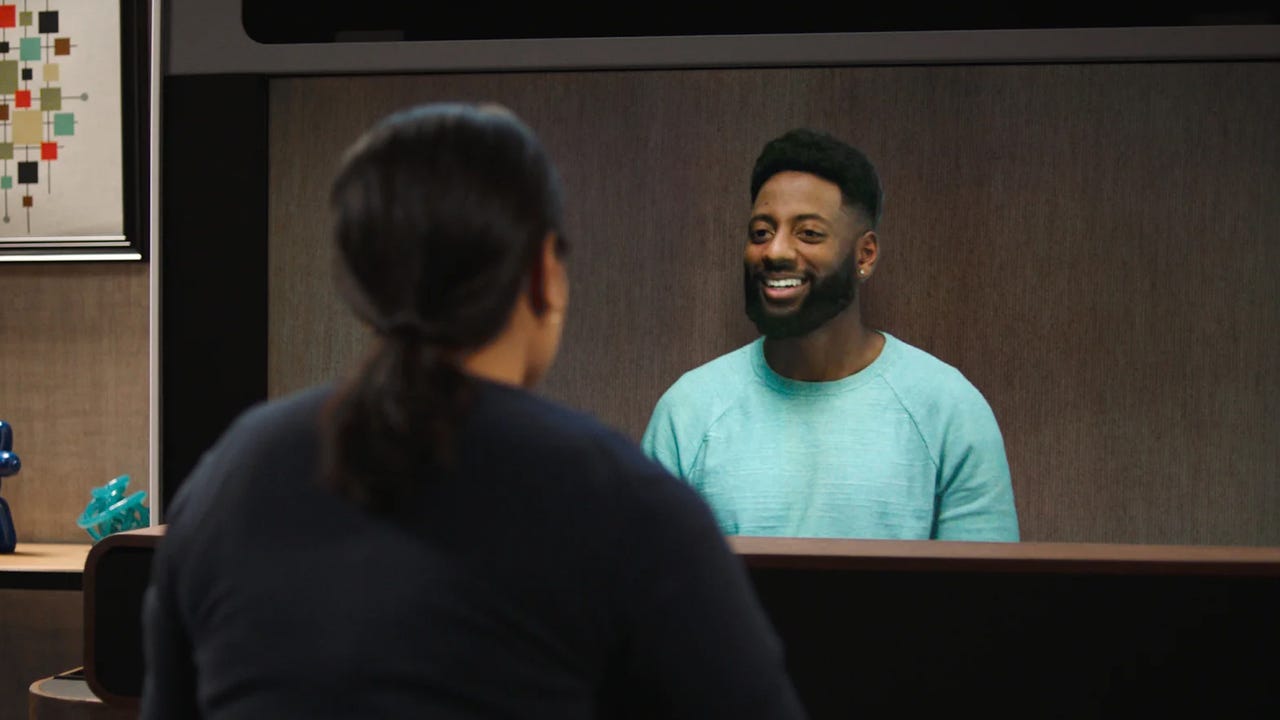
Google testing Project Starline during its research phase.
Since Google launched Project Starline in 2021, the company has been developing the technology as a video conferencing alternative to webcams. Instead of video conferencing with a coworker on a screen, Project Starline features a “magic window” — powered by AI and 3D imaging — that enables users to talk, gesture, and make eye contact as if they were in the same room.
Now, Google is announcing a partnership with HP and a plan to commercialize Project Starline in 2025, aiming to integrate it into other video conferencing services, like Zoom and Google Meet.
Also: 7 ways AI can fix your meetings, according to Microsoft
“With more than half of meaning and intent communicated through body language versus words alone, an immersive collaboration experience plays an important role in creating authentic human connections in hybrid environments,” said Alex Cho, president of Personal Systems at HP. “We are proud to partner with Google to bring this technology to market, harnessing the power of AI to shape the future of collaboration.”
Google has been testing the new technology extensively for the past few years, using it in its own offices and with enterprise partners. Feedback confirms that Project Starline meetings feel more natural than traditional video calls; users report feeling as if the other meeting participants are sitting across from them. The magic window has even improved attentiveness and memory recall, Google says, which mirrors the benefits of in-person interactions.
“Project Starline brings us closer to a world where distance is no longer a barrier to connection,” said Andrew Nartker, Project Starline’s general manager at Google. “We’re thrilled to partner with HP to bring this technology to future products together.”
Project Starline uses an array of high-resolution cameras with custom-built sensors to capture a user’s appearance and movements in 3D. AI algorithms process these images in real time to render a live video that shows nuances of facial expressions and gestures. A sophisticated display presents the 3D images to the other participants without the need for VR headsets or other equipment.
Also: Logitech’s Project Ghost draws on old camera tricks for better video meetings today
A specialized display is necessary to make Project Starline happen, however, which makes this solution more appropriate for conference rooms and offices than in-home use. This display is designed to offer true depth perception so participants can view images in three dimensions without using 3D glasses.
As work interactions shift away from cubicles and break rooms to Zoom meetings and Slack huddles, tech companies are working to make remote and traveling workers feel more united in hopes of supporting collaboration and work team culture. Just as Project Starline is designed to deliver a general sense of presence, the Apple Vision Pro does the same with its Persona, though in a virtual reality setting.
Also: Meta Quest 3 vs. Apple Vision Pro: How accurate was Zuckerberg’s review?
The Vision Pro’s personas have drawn mixed reactions from users; some tout its helpfulness while others describe the experience as straight out of uncanny valley. However, we can expect this to change as Apple improves its technology.
As Google commercializes Project Starline in the coming year, opening it up to the most demanding critics, we’ll see whether users jump at the chance of a Starline Zoom call.