

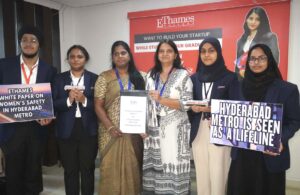
- Hyderabad Metro is seen as a lifeline — but women seek more safety after dark. Survey highlights poor awareness of the T-SAFE app, limited staff presence, and dimly lit stations.
- Survey found that Hyderabad is already aligned with many global best practices
Hyderabad, September 16, 2025: EThames Business School, Telangana’s fastest-growing B-School known for its employability-first, industry-integrated education under the leadership of EY veteran Kali Prasad Gadiraju, has released a white paper on “Women’s Safety in Hyderabad Metro Transit.”
The paper is authored by students Amena Begum, Khatija Tul Kubra, Taruni Reddy Gaddamedi, and Sukhjoth Singh Chawala with the help of their mentor Dr. Sahera Fatima. Based on 410 survey responses, several commuter interviews, and expert inputs from Hyderabad Metro Rail Ltd. and the Telangana Police Women Safety Wing, the study reveals:
- Women feel safe during the day, but perceptions of safety drop sharply at night. 11% of respondents surveyed reported harassment, but most cases went unreported due to fear or unclear protocols. Less than half knew of the T-SAFE app/helplines; only 12% ever used them. Commuters felt that the CCTV and women-only coaches exist, but poor monitoring, dim lighting, and limited staff remain concerns. It was found that Hyderabad Metro is on par with global metros in infrastructure but lags in enforcement and awareness.
- A few commuters suggested providing more seats on the metro platforms to help the elderly, pregnant women, people with knee problems and various disabilities. Waiting for a metro train, even for a few minutes, could be tiring for some, they felt.
- The team benchmarked Hyderabad against India’s 15 operational metros (from Kolkata Metro, 1984, to Pune and Navi Mumbai’s Maha Metro) and 247+ metros worldwide.
- Globally, the most effective systems blend hard measures (CCTV, fines, women-only coaches, security staff) with soft measures (awareness campaigns, anonymous reporting, gender audits, bystander training).
- The survey team observed the globally best practices and suggested the same, which include: Women-only coaches as seen in Tokyo, Dubai, Delhi, Seoul; Emergency help points/panic buttons in Mexico City, London; Mobile apps for anonymous reporting like in London, Toronto, Seoul; Large-scale anti-harassment campaigns run by Tokyo, Singapore, London, and Community partnerships prevail in New York’s Safe City, Delhi’s She Teams.
- Globally and in India, men travel more frequently by metro. The study notes that improved safety and awareness could shift this balance, linking female ridership to urban safety, workforce participation, and gender equality.
- The study highlights how cities like Delhi (women-only coaches), Kochi (inclusive hiring of women/transgender staff), and Tokyo/London/Seoul (higher female ridership due to trust in safety) prove that safety translates into empowerment.
- Hyderabad is already aligned with many global best practices, but must strengthen enforcement, awareness, and tech adoption to become a global role model metro.
- Beyond transport, metros are evolving into art galleries, social spaces, and cultural icons worldwide—symbols of urban speed, inclusivity, and transformation.
The Ethames Business School team’s recommendations for the Hyderabad Metro are ..
- Infrastructure upgrades such as better lighting, CCTV at street level, panic buttons, anonymous reporting systems.
- Staff reforms like more women personnel, gender-sensitivity training, clear safety protocols.
- Community engagement, such as safety audits, NGO partnerships, and awareness campaigns.
“The study cogently brings out several issues. Its recommendations will help us make Hyderabad Metro even safer for women commuters”, commented Mr. NVS Reddy, MD, Hyderabad Metro Rail Ltd.
“Every woman has the right to travel with dignity and confidence. This research energises our mission to make public transport safer”, said Shikha Goel, IPS, DG, Women Safety Wing, Telangana Police.
Did You Know? Fun Metro Facts!
Metros are more than transport — they’re art galleries, heritage showcases, shelters, and cultural icons moving billions every day. Here are a few that the EThames team, which worked on the survey, found to be interesting to read.
- The world’s First Metro is London’s “Tube”, opened in 1863 and is still running strong.
- India’s Pioneer: Kolkata Metro started in 1984.
- Though we call it Metro here, in New York it is called Subway, in London, is “Tube”, in Germany, U-Bahn.
- Delhi Metro is now among the world’s fastest-built large systems.
- Mega Rush: Delhi Metro carries 6 million+ passengers daily — more than the population of Finland!
- Art Underground: Stockholm Metro is called “the world’s longest art gallery” with 100+ art-filled stations.
- Heritage Touch: Hyderabad Metro stations reflect the city’s cultural design.
- Inclusivity First: Kochi Metro is the world’s first to employ women and transgender staff, also runs partly on solar power.
- Unexpected Finds: Delhi Metro’s construction unearthed fossilised elephant bones near Tughlakabad.
- Entertainment on the Go: Bengaluru Metro has even hosted live music gigs at stations.
- Built for Safety: Moscow Metro stations double up as nuclear bomb shelters.
- Longest Ride: Shanghai Metro stretches 830+ km — longer than the Delhi–Mumbai distance!