

NEW DELHI: Neha Sharma (name changed) was frantically searching for an oxygen cylinder as her husband was sinking when she came across a number on a WhatsApp group.
It was the last ray of hope for the 27-year-old as she had been unable to find a hospital bed. To her surprise, the caller agreed to supply the cylinder at home. She paid Rs 7,500 through Paytm on April 30 morning and kept waiting for help, but it never came. Her husband passed away in the evening on May 1.
Sharma was one of the hundreds of people who were hit by the double whammy of Covid-19 and fraudsters over the past one month.
When the second wave of the pandemic hit Delhi in April, it led to an extraordinary spurt in demand for oxygen cylinders, remdesivir, ambulances, concentrators, etc. In an urban set-up like Delhi, thousands took to social media to seek help. Initially, good Samaritans either helped them directly or shared details of credible suppliers. People called them and, in several instances, received assistance.
However, it didn’t take long for cyber fraudsters to spot an opportunity to cheat people on the pretext of supplying these commodities. They deceptively pushed their phone numbers on social media posts. For better visibility, they used popular and trending hashtags. This resulted in a large number of people losing not only their hard-earned money, but precious treatment time too.
Covid-related cyber fraud, hoarding, over-charging and black-marketing saw a sudden increase at the end of April. The situation seemed to be spinning out of control. Delhi Police, however, was quick to stand up to the challenge and commissioner SN Shrivastava launched an all-out war against these fraudsters.
A core team analysed the trends emerging from the complaint data, social media and cheating cases registered during the first Covid wave in 2020 and a series of measures were launched to counter this rapidly growing menace.
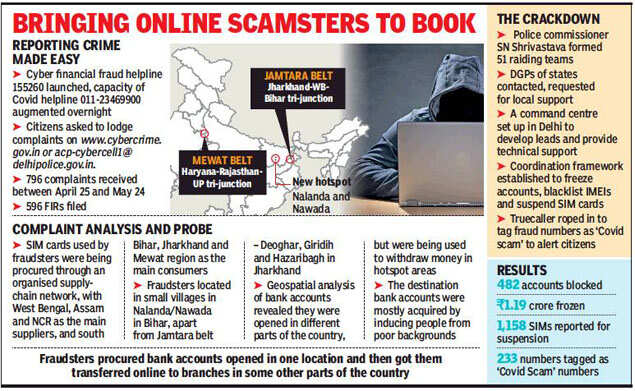
“The capacity of the Covid helpline 011-23469900 was augmented overnight for easy and direct reporting of fraud cases. Simultaneously, awareness campaigns were initiated requesting citizens to lodge complaints on www.cybercrime.gov.in, cyber financial fraud helpline 155260 and dedicated email IDacp-cybercell1@delhipolice.gov.in,” said Shrivastava.
In all, 796 complaints were received from April 25 to May 24 and 596 FIRs were subsequently registered. The callers’ locations revealed that most of them were based out of Delhi. As many as 51 raiding teams from cyber cell, crime branch and local police were formed and sent to different places to arrest the cheats. The police chief himself contacted the DGPs of the states concerned for local support.
Delhi Police also reached out to Indian Cyber Crime Coordination Centre (I4C) of the Union home ministry and through it contacted the national banking and financial sector, regulators of the telecom industry and leading private players and operators to mount a multi-pronged attack on the scamsters.
The SIMs used by the fraudsters were procured through an organised supply-chain network with West Bengal, Assam and Delhi-NCR being the main suppliers and south Bihar, Jharkhand and Mewat as the main consumers. The callers were mostly located in a small belt falling in districts like Nawada and Nalanda, which are in close proximity to the Jamtara Belt — Devghar, Giridih and Hazaribag districts of Jharkhand.
This new hotspot in south Bihar suggested that cybercrime as a cottage industry had fanned out to the neighbouring region. Investigations revealed that the kingpins had received hands-on training from their peers in Jamtara. Bank accounts were opened in different parts of the country, but money was withdrawn by the fraudsters in the hotspot areas.
Moreover, the fraudsters had adopted a new strategy of opening bank accounts in one location and then transferred them online to branches in other parts of the country. In many instances, they gave the IFSC code of a Delhi-NCR branch for receiving advance payment to trick victims into believing that they were genuine suppliers based in Delhi-NCR. The scamsters also hacked netbanking details of genuine people to re-route the defrauded money.
“After analysing their modus operandi, the entire network was attacked by obstructing supply lines, which involved getting the beneficiary accounts frozen, SIM cards suspended pending KYC re-verification and blacklisting the phone IMEIs. Coordination with TrueCaller helped tag the numbers as ‘Covid scam’, thereby alerting people about it,” said an officer.
As a result, 366 people were arrested, 482 bank accounts blocked, Rs 1.2 crore frozen, 1,158 SIMs reported to DoT for suspension, and 233 numbers were tagged as ‘Covid scam’. The scale of this crackdown has been termed as unprecedented in Delhi Police’s history of cyber crime investigation. Among those arrested included the conmen from Nalanda who had duped Sharma.
Source Link