























- LATAM smartphone shipments declined 24% YoY in Q3 2026, the second-lowest quarter since 2015, driven by memory shortages, the resulting price increases and Chinese brands prioritizing supply to their home market.
- Samsung retained the top spot and gained share, as its 15% decline was well below the market average. Motorola held second place, with its decline in line with the market.
- Apple posted the smallest decline among the top five brands (-10% YoY) and moved up one position, supported by its ability to absorb price increases, strong product availability and the iPhone 18 Pro series launch at the end of the quarter.
- The region’s two largest markets – Brazil (-22%) and Mexico (-26%) – both posted sharp YoY declines. Weaker local production and pre-election uncertainty weighed on Brazil, while post-World Cup spending fatigue and seasonal expenses hit demand in Mexico.
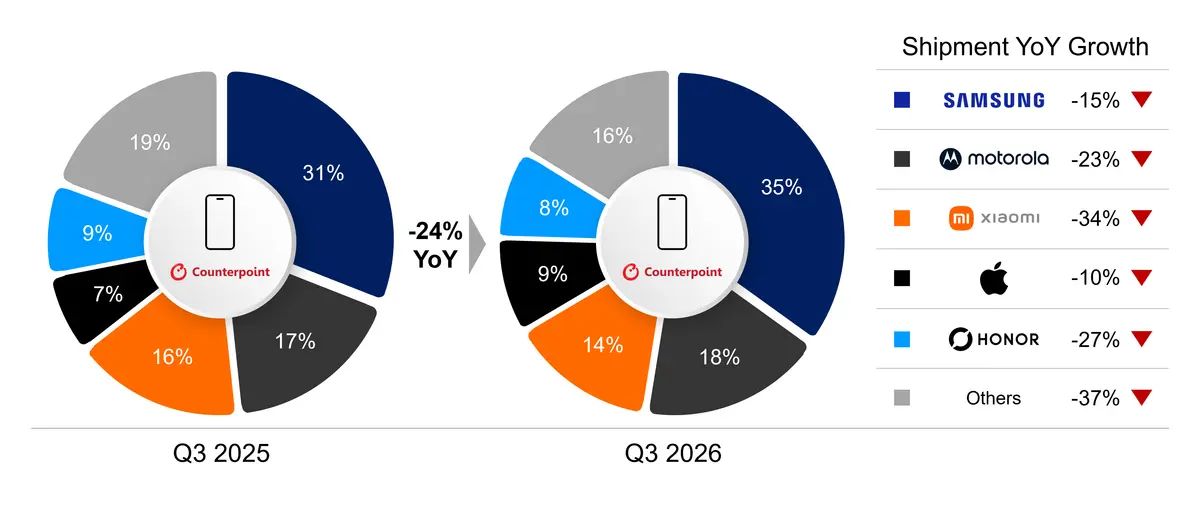
According to Counterpoint Research’s Q3 2026 Market Monitor report, Latin America’s smartphone shipments contracted 24% YoY, the region’s second-lowest quarterly volume since 2015. Only Q2 2020, during the pandemic lockdowns, was lower. The steep decline was driven mainly by memory shortages, the resulting price increases and Chinese brands allocating more supply to Asian markets. Samsung remained the market leader with a 35% market share.
Commenting on the market dynamics, Principal Analyst Tina Lu said, “On the demand side, private consumption in the region slowed as consumers became more cautious with their spending. The impact was even sharper for smartphones, as many consumers postponed replacements or turned to repair services after the steep price increases in Q3 2026. On the supply side, most brands posted double-digit declines even though Q3 is typically when LATAM sales channels build inventory for the holiday season. The relative winners this quarter were the brands that limited their declines in a shrinking market – in other words, those that had secured memory supply before the crunch hit.”
LATAM Smartphone Shipments by OEM, Q3 2025 vs Q3 2026 YoY
Source: Counterpoint Research Market Monitor, Q3 2026
Samsung kept its regional lead in Q3 2026. Its shipments fell 15% YoY, well below the market’s 24% decline, which lifted its market share by 4 percentage points. Samsung had the strongest product availability in both the entry-level segment and the premium Galaxy S series. It also kept a strong presence across physical and online channels, backed by aggressive discounting.
Motorola’s shipments fell 23% YoY, roughly in line with the overall market, so its share held steady. The brand strengthened its position through broad product availability across sales channels and increased visibility from its sponsorship of the FIFA World Cup 2026 and Formula 1, where it partnered with Argentine driver Franco Colapinto and Brazilian driver Gabriel Bortoleto.
Apple was the most resilient, with the smallest decline among the top five brands (shipments down 10% YoY), and rose one position to No. 4 in the region. Apple absorbed the impact of price increases better than its rivals, helped by strong product availability. Apple launched the iPhone 18 Pro series at the end of the quarter. For the first time, Chile joined Brazil and Mexico in the first launch wave.
Xiaomi posted the steepest decline among the top five brands, with shipments down 34% YoY. The drop was driven mainly by product supply constraints, as the brand once again prioritized supply for its home market in China.
Honor’s shipments fell 27% YoY, mainly due to product supply constraints. The region’s smaller markets, which had driven Honor’s growth in LATAM, were hit the hardest in Q3 2026. Supply constraints also slowed the brand’s ramp-up in Argentina, a market it entered only recently.
Commenting on the country-level results in Q3 2026, Senior Analyst Benjamin Corona said, “Beyond the global supply challenges, the region’s three largest smartphone markets each faced their own headwinds. Brazil’s shipments fell 22% YoY as local smartphone production slowed amid tight memory supply and uncertainty around the presidential election. Mexico declined 26% YoY as household budgets were stretched after the FIFA World Cup, the summer vacation season and back-to-school spending. Colombia’s shipments fell 28% YoY, weighed down by high inflation and the transition to a new administration following this year’s presidential elections.”
LATAM smartphone shipments came under pressure in Q3 2026 as memory-driven price increases outpaced OEM and retailer discounts, leading consumers to wait for November promotions and the holiday season. Counterpoint expects the decline to ease in Q4 2026 as prices stabilize and seasonal demand returns. Memory-related price pressure should moderate by Q2 2027, but supply constraints will likely continue through the end of 2027.

