

Research Highlights Inflection Point for Warehouse Digital Transformation
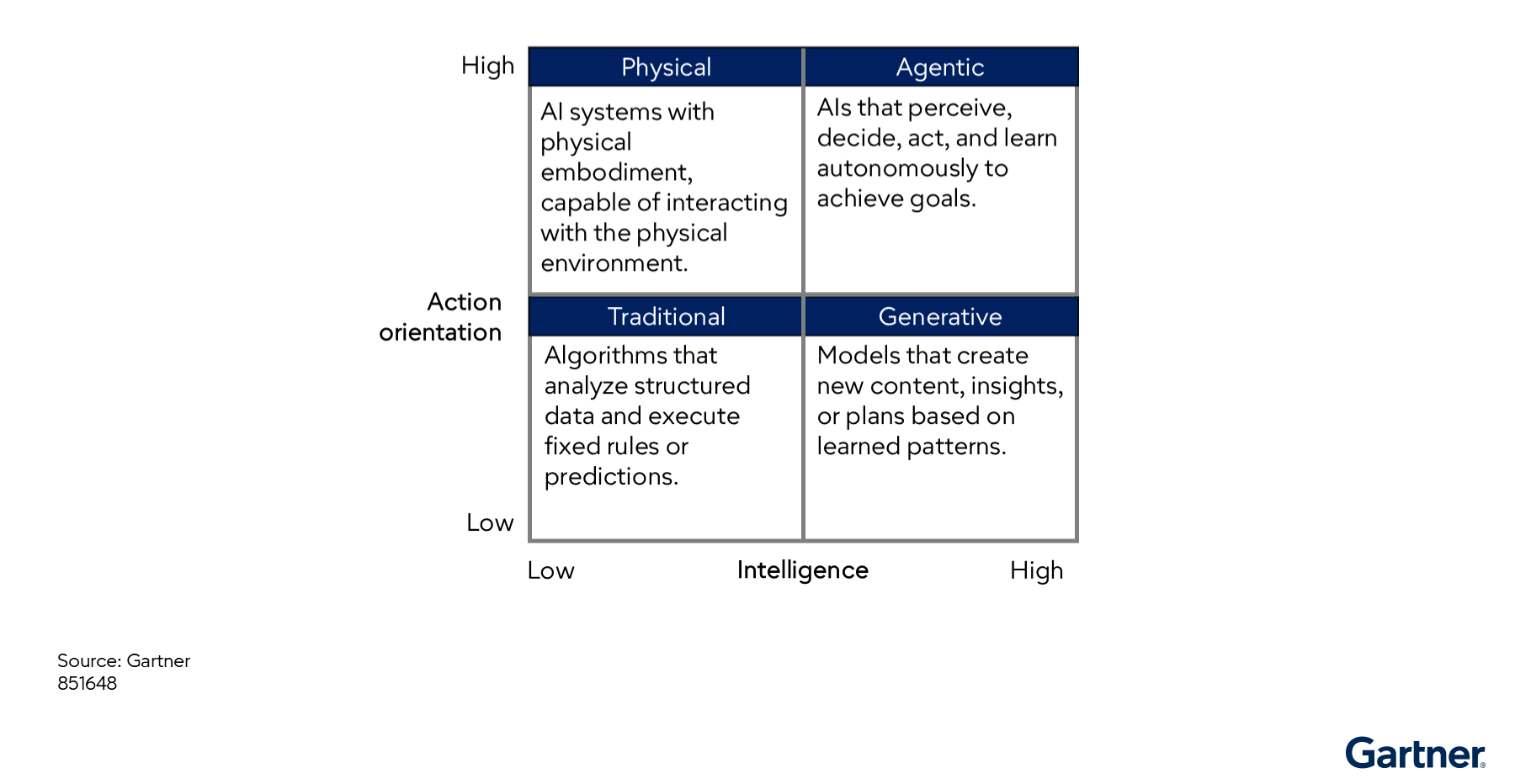
Gartner’s research identified four AI trends that each align to a distinct dimension of AI maturity and application (see Figure 1). Future success will depend on balancing two dimensions of AI — “action orientation” and “intelligence sophistication” — across the four core categories. The four AI trends include:
- Enhanced Optimization-Oriented Traditional AI
- Operational-Driven Generative AI
- Suggestive and Semiautonomous Agents
- Physical AI Agents
“These four AI trends are interconnected and reflect the evolution of a more intelligent, adaptive and resilient warehouse environment,” said Federica Stufano, Senior Principal Analyst in Gartner’s Supply Chain practice. “As labor pressures persist and AI technologies mature, organizations are moving beyond experimentation toward operational deployment. Their success will depend on building trust through transparent AI decision making, enabling effective collaboration between workers and intelligent systems, and applying these technologies in ways that address specific operational challenges.”
Figure 1: The Four AI Warehousing Categories – Action Orientation vs. Intelligence
Source: Gartner (September 2026)
Trend 1: Enhanced Optimization-Oriented Traditional AI
Trend 2: Operational-Driven Generative AI
Trend 3: Suggestive and Semiautonomous Agents
Trend 4: Physical AI Agents
“Supply chain leaders should take a pragmatic approach to AI in warehousing by tackling proven use cases, such as labor forecasting and slotting, and expanding into generative AI and agents where it can improve decision-making and workforce productivity,” said Stufano. “Maintaining human oversight while continuously evaluating new use cases will be critical to realizing AI’s full potential across the supply chain.”