

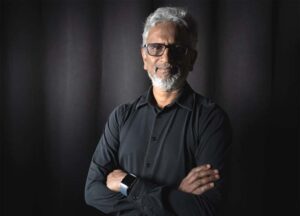
Hyderabad, India / CAMPBELL, CA, July 1, 2026 – OXMIQ Labs Inc., a unified GPU and AI architecture company founded by Raja Koduri, today closed its $35 million Series A financing, bringing the company’s total capital raised to $60 million. The funding will scale OxCore, OXMIQ’s licensable GPU architecture that allows semiconductor companies and AI system builders to build custom AI silicon without a full chip program. The round was co-led by Fundomo and Samsung Catalyst Fund, with participation from MediaTek, AM Intelligence Labs, Pegatron Venture Capital, CDIB-TEN, Darwin Ventures, and Morgan Creek Digital, among other financial and strategic investors. OXMIQ’s expertise spans the full AI stack, from renewable power and data center infrastructure to silicon IP, electron-to-token machines (ETMs), along with the software that runs AI factories and agents.
One Core, Three Engines
Token demand is outpacing the world’s ability to build infrastructure to serve it. OXMIQ was founded to re-architect the GPU stack from Atoms to Agents, building the silicon IP, configurable systems and software platform that enable semiconductor companies and AI infrastructure builders to drive down the cost of intelligence at every layer of the stack.
At the center of the architecture is OxCore, a scalable, licensable GPU core that integrates three distinct compute engines: a CUDA-compatible GPU engine, a tensor processing engine, and an orchestration engine (CPU) responsible for coordinating workloads and agents across the system. OxCore tightly couples compute functionality that is typically split across three chips, and was purpose-built for near-memory compute, minimizing data movement to enhance compute and energy efficiency of AI workloads. OxCore was designed for scalability and the architecture scales efficiently from single-core AI deployments to large-scale datacenter configurations. OxCore is running on FPGA today, with live demonstrations available.
OxQuilt, OXMIQ’s chiplet integration architecture, combines heterogeneous compute chiplets and memory in a single package. Most AI silicon designs are locked to a specific foundry and memory type. OxQuilt instead adapts to any supply chain, with configuration tools that let customers design across logic process nodes, memory types, interconnect standards, and advanced packaging options. By making high-performance AI compute licensable and configurable, OXMIQ lets any design team build custom AI silicon packages without needing cost-prohibitive full chip programs. The architecture is also designed to incorporate emerging interconnect technologies such as silicon photonics as they reach production readiness.
OXMIQ pairs the hardware with a software stack spanning OxCapsule for high-level orchestration to low-level kernel optimization. OxPython runs existing CUDA and PyTorch code on OxCore without code changes, giving developers full portability across hardware. This stack supports emerging silicon architectures for optimized inference at scale and delivers day-zero support for new models. OxPython has been validated on third-party platforms with live demos available.
OXMIQ’s IP-first model is built for capital efficiency. By focusing on new architecture IP rather than full SoC development, the company generates revenue from customer engagements while preserving capital for building the stack.
“We are very excited to co-lead OXMIQ’s financing round and back Raja Koduri and the strong team at OXMIQ.” said David (Dede) Goldschmidt, SVP & Managing Director, Head of the Samsung Catalyst Fund. “OXMIQ’s novel AI core and software platform enable heterogeneous compute for efficient, custom inference solutions serving large-scale agentic workloads.”
“Raja has built silicon at every layer of the stack, and he knows exactly where the constraints sit. Most compute IP makes the customer bend their memory, packaging, and foundry around the chip. OXMIQ does the opposite, and that flips a cost center into leverage. We backed this team because they will define how AI compute gets built this decade,” said Rajeev Surati, Partner at Fundomo.
An Expanding Team
OXMIQ has strengthened its board and advisory ranks with two additions that bring decades of silicon pedigree. Jim Keller, CEO of Tenstorrent and among the most influential chip architects in the industry, joins the board of directors alongside existing board member Dr. Ker Zhang. Dr. Valluri (Bob) Rao, a renowned Fellow who retired from Intel’s process technology group, joins as an advisor. Together, they deepen OXMIQ’s leadership as the company moves from architecture to customer integration.
“I am excited to join the OXMIQ board. Raja and this team are creating an open GPU architecture, a much-needed step toward removing the artificial boundaries around AI innovation. As the industry concentrates around a few incumbents, this is more important than ever. OXMIQ’s open, configurable foundation, which developers can build on and own, is exactly where compute should be heading,” said Jim Keller, CEO of Tenstorrent and OXMIQ board member.
Raja Koduri, OXMIQ founder and CEO, added: “A licensable core with an open architecture means design teams everywhere can build the custom AI silicon their work needs. Today, state-of-the-art AI reaches most people through a handful of channels, and the cost of the compute underneath is the reason. Bring that cost down, and you widen who gets to build with it. I believe AI is a force for good when it is a tool everyone can pick up and use, not just the few who can afford to build with it. Closing this round with investors who own the supply chain tells us we can get there.”