

Gartner Survey Shows Leadership Turnover Is Harming Supply Chain Performance
Gartner surveyed 227 supply chain leaders in June 2025 across industries and regions, aimed at identifying leadership development strategies that enable CSCOs to have employees fully capable and prepared to assume head of function roles.
“Effective supply chain leadership has to shift from an overreliance on individual superstars, who our research has found are less collaborative, to leaders who are motivated and equipped to amplify the performance of their teams and organizations,” said Tess Frenzel, Senior Principal Analyst in Gartner’s Supply Chain practice. “CSCOs who are able to adapt their leadership strategies to build these types of leaders and design the roles and development programs to help them succeed will improve supply chain performance, despite the disruption inside and outside of their organizations.”
Gartner’s survey data paints a concerning picture of the reality for today’s supply chain leader:
- Only 22% of supply chain leaders exhibit collectively motivated behaviors that correlate to stronger organizational business outcomes, with the majority exhibiting individually motivated performance.
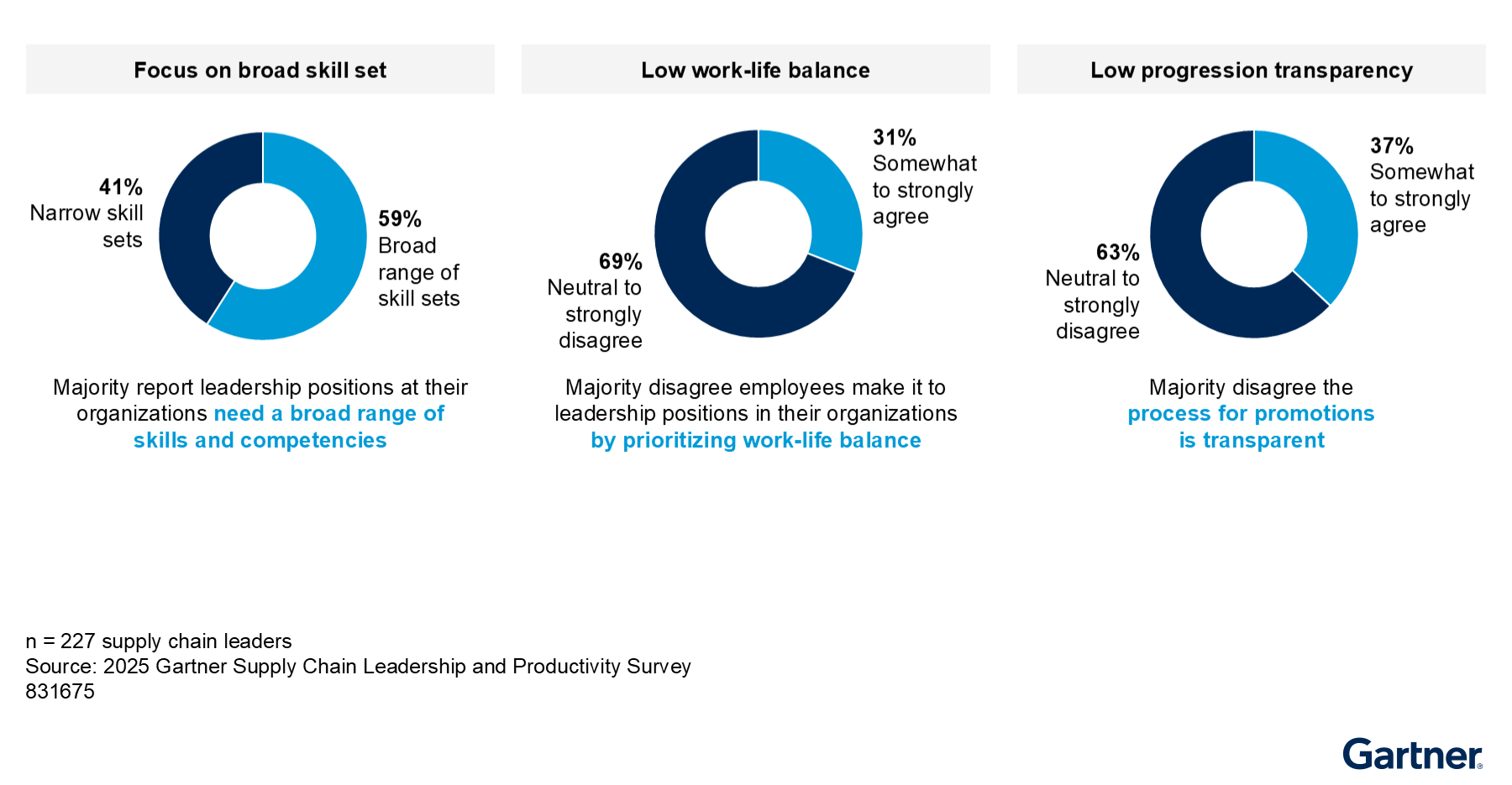
- Supply chain leadership positions continue to expand in responsibility and scope, with 59% reporting positions at their organization require a broad range of skills and competencies.
- Less than half (49%) of leadership development programs are rated as effective, highlighting a need for more dynamic, tailored approaches that keep pace with the rate of technological change.
Additionally, supply chain leaders have a negative view of the path required for higher leadership positions, with few reporting work-life balance as part of the path to leadership (31%) and less than half (37%) agreeing that the process for promotions is transparent (see Figure 1).
Figure 1: Supply Chain Leaders’ Perception of Leadership Role Qualities
Source: Gartner (December 2025)
Building Future-Ready Supply Chain Leaders
Gartner’s research on supply chain leadership development identified three critical shifts for CSCOs seeking to build a future-ready leadership bench:
- Develop and Reward Collectively Motivated Leaders: High turnover and siloed incentives undermine continuity and collaboration. CSCOs must shift to rewarding leaders who amplify team and cross-functional performance and not just deliver individual results.
- Combat Role Overexpansion: Overly broad leadership roles erode effectiveness and increase disruption risk. Clearly defined, scoped roles aligned to strategic priorities and work-life balance are essential for sustainable performance.
- Unlock Agile Leadership Development: Traditional, static development programs are failing to keep pace with change. CSCOs must leverage new technologies, partnerships, and embedded learning to accelerate leadership growth and adaptability.