

The Google Pixel 8 and the Google Pixel 8 Pro were launched in October 2023 and have since proved to be two of the best phones you can buy. But what’s the difference between them? And which one should you get?
To sum things up: the Google Pixel 8 is more affordable with a smaller screen and stripped-back features. The Google Pixel 8 Pro is the crown jewel, it’s expensive but has everything you could need from your next handset, and more.
Whichever you choose, Google Pixels are stylish with impressive displays, they can shoot stunning photography and they lead the way when it comes to clever AI features like the Magic Eraser and Live Transcribe. More than that, the best Pixel phones are better value than Apple’s top devices or the best Samsung phones.
At any time, you can find plenty of Google Pixel 8 deals. There’s no need to wait until Prime Day or Black Friday to buy a handset at a great price.
If you would like to save some extra cash, you might want to consider one of the best Google Pixel 7a deals instead, or a previous-generation handset like the Pixel 7.
Google Pixel 8 vs Google Pixel 8 Pro
At launch, the Google Pixel 8 would set you back £699 whereas the Google Pixel 8 Pro would cost £999 for the models with 128GB of storage. We’ve seen them on sale for much less than that since then.
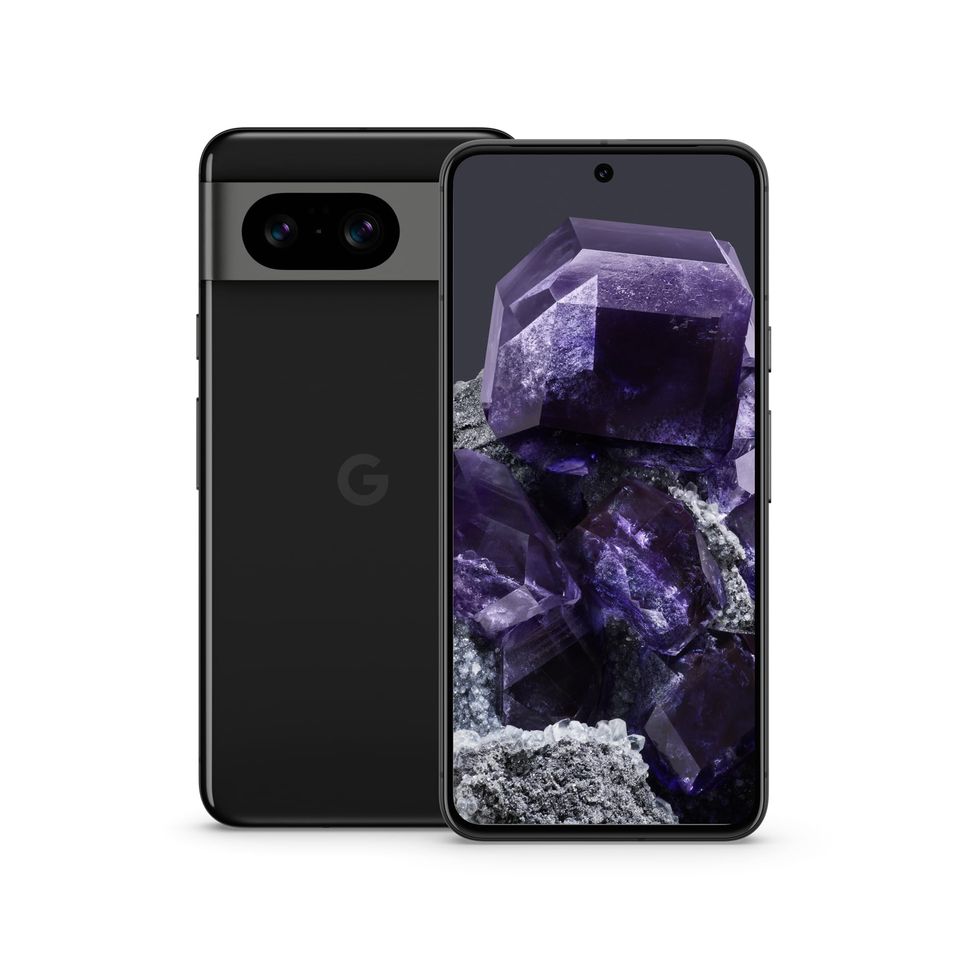
Google Pixel 8

Google Google Pixel 8 Pro
Now 24% Off
Google Pixel 8 vs Google Pixel 8 Pro: design and display
The Google Pixel 8 and the Google Pixel 8 Pro look almost identical, which isn’t surprising given they come from the same generation of devices.
Both have a flat screen with rounded edges. Both have a camera bar on the back that stretches across the whole width of the device (although the Pro model has a slightly bigger cutout to allow for an extra lens). Both are IP68 water and dust-resistant and both are made from glossy glass. The Pixel 8 Pro has a slightly more durable Gorilla Glass Victus 2, the Pixel 8 uses the original Gorilla Glass Victus.
The most obvious differences between the two are the available colourways. The Pixel 8 comes in Obsidian (black), Hazel (green) and Rose (pink). The Pixel 8 Pro, on the other hand, comes in Porcelain (white) and Bay (blue) as well as the standard black option.
You’ll notice that the Pixel 8 is much smaller than the 8 Pro. That’s down to screen size. The Pixel 8 has a 6.2-inch display and the Pixel 8 Pro has a 6.7-inch screen. Because it’s smaller, the Pixel 8 is also lighter at 187g instead of 213g.
Size could be a deciding factor for you — a compact phone is more pocket-friendly and better for people with small hands, whereas a big phone gives you lots of room for watching shows like Heartstopper on the best streaming services or editing your holiday pictures.

Google Pixel 8

Google Pixel 8 Pro
The Pixel 8 Pro has a higher resolution display of 1344 x 2992 pixels, in comparison to the Pixel 8’s 1080 x 2400 pixels. The Pro is brighter too, reaching 2,400 nits peak brightness in contrast to the 2,000 nits offered by the Pixel 8.
The extra pixels and higher brightness make the display on the Pro model better for streaming and gaming, but won’t make a massive difference for more day-to-day tasks.
Both phones use OLED panels, and both have a 120Hz refresh rate making them equally satisfying for scrolling and swiping.
Away from the design and display, there’s one feature that the Google Pixel 8 Pro has that the Google Pixel 8 doesn’t — a temperature sensor. It sits within the camera module and can be used to check how hot or cold an item is, be that food, drinks or anything else you can think of. When the Digital Spy team tested out the Pixel 8 Pro, we weren’t convinced by the need for it, but other people might find it more useful.
Google Pixel 8 vs Google Pixel 8 Pro: cameras
Google Pixel smartphones have great cameras — partly because of hardware and partly because of software. Clever AI processing and editing features help you get the most out of any scene or photo, and that applies to all its gadgets, including the Pixel 8 and 8 Pro, the Pixel Fold and even the budget Pixel 7a.
The Google Pixel 8 Pro has more advanced hardware than the rest of the Pixel family, making it one of the best phone cameras in the world. It’s made up of a 50MP main lens, a 48MP ultrawide camera, a 48MP telephoto lens with 5x zoom and a 10.5MP selfie snapper.

Google Pixel 8

The Google Pixel 8’s camera is more modest but still very effective — it uses the same 50MP main lens and 10.5MP front camera as the 8 Pro, alongside a 12MP ultrawide camera, but there’s no dedicated zoom lens. The Pixel 8 is limited to digital zoom, cropping the scene rather than bringing the subject closer like the Pixel 8 Pro. Google uses AI to enhance its zoomed shots so the Pixel 8 doesn’t do a bad job of things by any means but you’ll be able to get a lot more from the telephoto lens in the Pro model.
In Digital Spy‘s review, we described the Pixel 8 as having “a very capable point-and-shoot setup that makes taking great shots effortless – even in low light”. The Pixel 8 Pro takes things a step further, though, we described it as being “the Android phone for power users and photographers”. If you take a lot of photos, and you intend to regularly print them out or use them away from social media, the extra detail you’ll get from the Pro will be worth splashing out on.
While both smartphones support 4K charging up to 60fps, only the Pixel 8 Pro comes with the Video Boost feature which enhances footage quality and improves lighting.
Google Pixel 8 vs Google Pixel 8 Pro: performance and software
Under the hood, the Pixel 8 and Pixel 8 Pro use the same Google Tensor G3 processor. Despite being quite fast, it doesn’t match the speeds of other top-of-the-range chipsets, like the A17 Pro in the iPhone 15 Pro or the Qualcomm Snapdragon 8 Gen 3 used by the Samsung Galaxy S24 Ultra.

The Pixel 8 has 8GB of RAM whereas the Pixel 8 Pro has 12GB of RAM. Because of that, the Pro model is marginally faster than its more affordable counterpart, although most people won’t know the difference. It will be more noticeable if you need a powerhouse for work or gaming.
The devices come in a few different storage options, with the Pixel 8 going up to 256GB of internal storage and the 8 Pro getting options up to a massive 1TB. Neither has an SD card slot to expand the memory.
Whichever of the Pixel 8 devices you buy, you’ll get Android 14 with software updates for around seven years. That makes them useable until the 2030s!
Google Pixel 8 vs Google Pixel 8 Pro: battery
The Google Pixel 8 Pro has a bigger 5,050mAh battery than the Google Pixel 8’s 4,575mAh cell. In saying that, it has to work harder to power a larger display and more advanced hardware. Ultimately, both devices will last all day without needing a charge, and even into the next day at times.
If you’re using a cable, the Pixel 8 supports 27W charging and the Pixel 8 Pro supports 30W charging, so charge at similar rates. Both devices also offer wireless charging.

Google Pixel 8

Google Pixel 8 Pro
Google’s Adaptive Charging feature works across both handsets too. It learns your habits and slows charging down the longer you leave your device plugged in which should protect the battery over time.
Google Pixel 8 vs Google Pixel 8 Pro: verdict
There’s no question about which is the better phone — the Google Pixel 8 Pro is one of the best (if not the best) iPhone alternatives in 2024.
However, for some people, the Pro model’s advanced features and hardware will be overkill and not worth spending an eye-watering amount of money on. If you’re happy with something smaller, and don’t mind making a few minor sacrifices then the Google Pixel 8 is a worthy handset. It’s the best Android phone for most people at the time of writing.