

In an effort to save time processing goods and improve tax collections, the Guam Customs and Quarantine Authority can now move from paper cargo manifests to an automated system because of a newly signed law.
The hardware for the system, which could cost about $1 million, has yet to be procured, while the software will be donated by the United Nations, officials said.
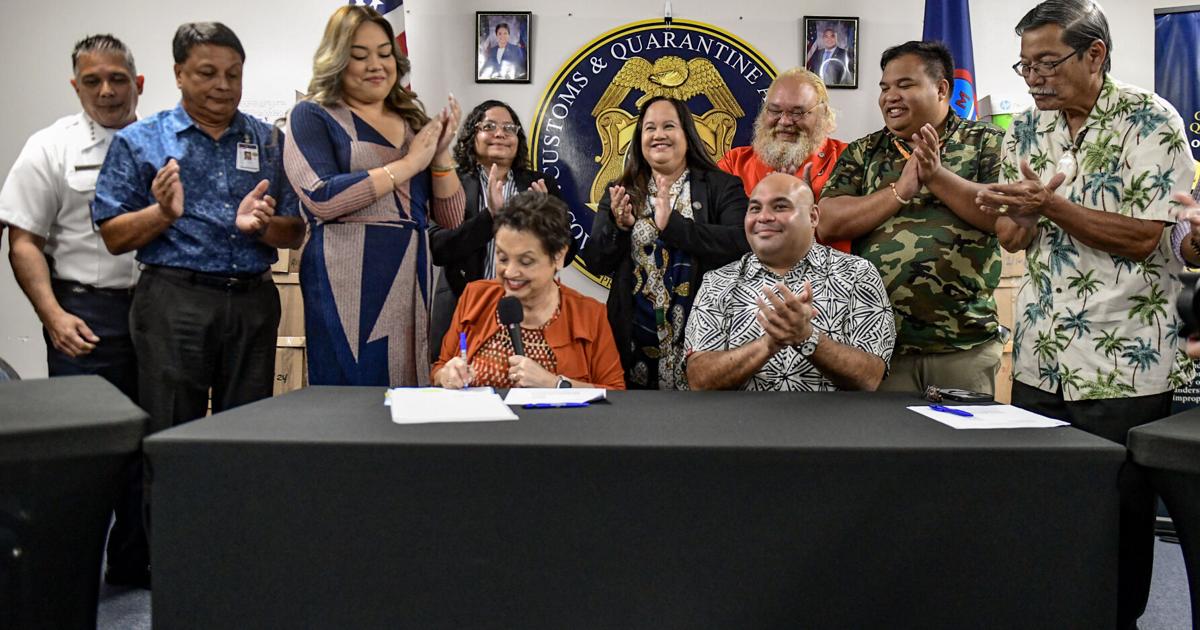
Gov. Lou Leon Guerrero on Tuesday signed Vice Speaker Tina Muña Barnes’ Bill 176-37 into Public Law 37-82, allowing the launch of the new automated system, during a ceremony Tuesday at the Guam Integrated Air Cargo Facility in Tiyan.
The governor said the new system would help get imported goods “from ship to store, from ship to the table, from ship to the families” more quickly.
Several boxes of paper stacked to about head-height were in the conference room where the ceremony was held, altogether containing documentation for about $320 million worth of goods that arrived on Guam just this February.
Customs Director Ike Peredo said the need to move away from paper logbooks and towards a modern system was flagged about 20 years ago during his time as a customs officer.
Besides automating paperwork, using a new Harmonized Customs and Coding System, the official “language” of international trade, would help Customs to track data about every good that comes into the island and plays a role in the economy, Peredo said.
Missed taxes
Potentially raking in tens of millions more in taxes for the government of Guam is another goal for the new system, according to the vice speaker.
Muña Barnes pointed to a 2018 audit which found GovGuam lost out on potentially $65 million worth of revenue due to a failure to properly tax the $1.6 billion worth of goods that came into the island that year.
She compared the process of combing through a warehouse of cargo manifests to “finding a needle in a haystack.”
Keeping track of use taxes applied to incoming cargo on the all paper system has been an issue, according to Chief of Customs Vince Perez.
“You could possibly get away with coming in and saying, ‘I’m exempt from the use tax.’ And because we’re so paper based, it’s hard to cross check with the Department of Revenue and Taxation,” he said.
Perez said a module planned for the new system will identify when exemptions apply and when they don’t.
The vice speaker stressed that the new law does not change current use tax exemptions.
$1M hardware
An estimate for new hardware for the system is still outstanding, but it’s expected to cost about $1 million, according to Peredo.
The director said the Bureau of Statistics and Plans is helping Customs find grant money to cover the costs.
He added that software for the new system will be donated to Customs by the United Nations, through a negotiated deal.
Perez said the agency wants to get the system up and running in about 18 months, if not sooner.
Customs will be taking input from stakeholders in the community to iron out fines for violating the new system, as well as any fees, Perez said. He said Customs does not plan to pass the costs for the system on to consumers.
The agency is authorized to implement new fines and fees as necessary, under the new law, and will have to gather input from public hearings as required by the island’s Administrative Adjudication Act.
Hefty fines scrapped
Fines included in an early draft of the bill that became Public Law 37-82 weren’t included in the final version, following concerns raised by the Guam Chamber of Commerce.
Chamber President Catherine Castro wrote to senators that many businesses will have early troubles adopting the new classification system, and might have to contend with steep fines.
Proposed fines started at up to $5,000 on first violation, and up to $30,000 for three or more violations, but were dropped in favor of letting Customs iron out the details.