

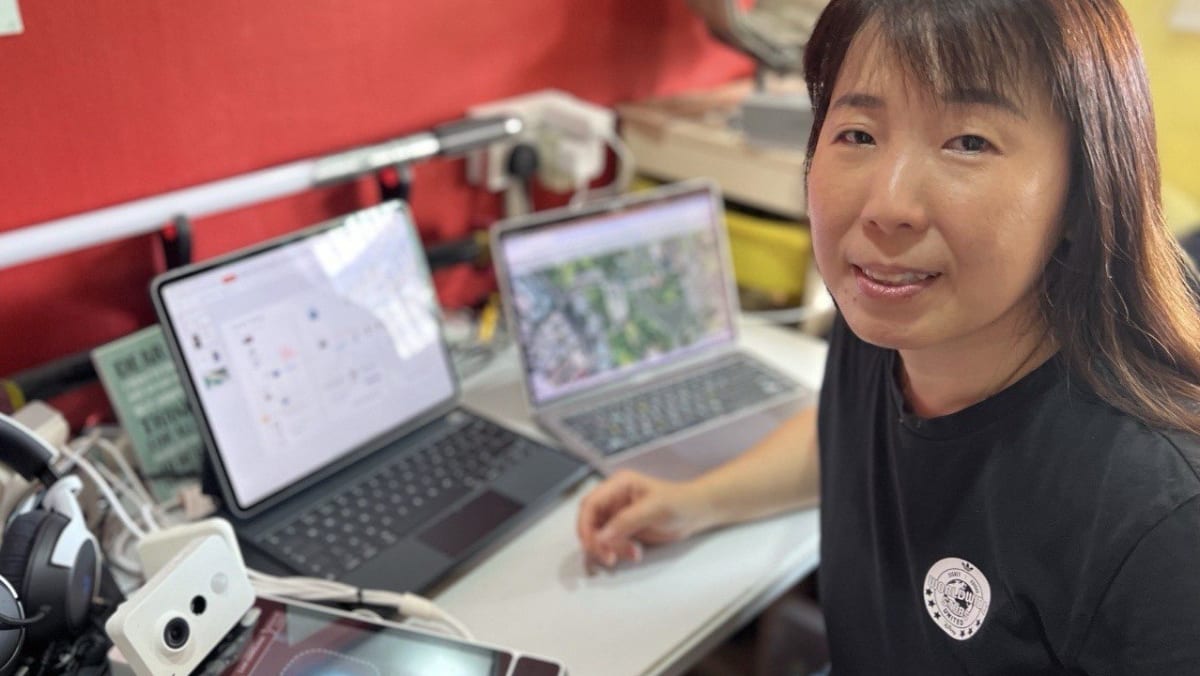
You may not have seen Khoo Ri Na, but you have probably come across her work. The 48-year tech expert was part of the initial team that the Singapore Police Force (SPF) engaged to develop police cameras (PolCams) for 10,000 Housing Development Board (HDB) blocks across Singapore – her work was instrumental in helping the police solve crime.
She was also part of the team that worked with a healthcare provider to create a system documenting the screening of lorry drivers and travellers coming through Singapore’s land checkpoints for their COVID-19 vaccination history at the beginning of the pandemic.
Khoo’s latest project is also healthcare-related: She is building a location monitoring device that can be inserted into the footwear of persons with dementia to keep them safe.
Her tech solutions address key security and healthcare concerns. Khoo however, was not formally trained in tech. In fact, she majored in business and marketing in university, and started her career in a marketing and communications role at a security solutions company.
FROM NOOB TO TECH EXPERT
A Gen-Xer, Khoo grew up in the 80s and 90s when modern-day technology was in a very nascent stage. Smartphones were hardly heard of then.
In those days, listening to music meant lugging around a Walkman, or later, a CD player or MD player. Taking good photos meant investing in a DSLR camera.
Khoo loved these gadgets. “I have always appreciated how technology can improve quality and productivity,” she said.
Her love for technology even led her to assemble her own central processing unit (CPU) for her computer 30 years ago, when she was in her teens.
Because YouTube had yet to be invented then, and there were no how-to videos, Khoo hung out at Sim Lim Square, the go-to place for electronic and computer parts, to learn how to put a CPU together from store owners and friends.
“At the time, if you wanted a certain computing power, you had to either build the CPU yourself or pay a lot for it.
“So I bought parts such as the processor, RAM (random access memory) and a transparent enclosure (case) because I wanted to see the parts and lights when using it, and built my own CPU,” she laughed, adding that she continued assembling, modifying and upgrading her CPU for many years.