

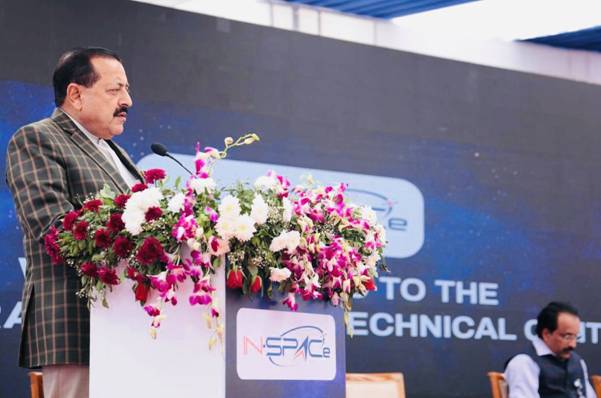
India targets a five-fold increase in its share of the global space economy, Union Minister Dr Jitendra Singh said, addressing the gathering after launching the Technical Centre of IN-SPACe in Ahmedabad.
“India’s Space economy today stands at a modest $8 billion, but our projection is that by 2040 it will multiply manifold. But more interesting is that according to some international observers, for example, the recent ADL (Arthur D Little) Report mentions that we could have the potential of $100 Billion by 2040,” he said.
Dr Jitendra Singh said India’s quantum leap in the Space sector has only been possible after Prime Minister Shri Narendra Modi took the courageous decision to “unlock” this sector from the “veil of secrecy”.
“Prime Minister Shri Narendra Modi has broken taboos of the past by opening the Space sector to public-private-participation,” he said.
The Union Minister gave full credit to PM Modi for enabling India’s Space scientists to vindicate the dream of their founding father Vikram Sarabhai by “unlocking” India’s Space sector and providing an enabling milieu in which India’s huge potential and talent could find an outlet and prove itself to the rest of the world.
“Even though talent was never lacking in the country, the missing link of the enabling milieu was created under the leadership of PM Modi. With the opening up of the Space sector, the common masses have been able to witness the launch of the mega Space events like Chandrayaan-3 or Aditya,” he said.
Dr Jitendra Singh said, four-five years back, we had just one digit Startups in the Space sector, today we have nearly 200 private Space Startups after opening up of the sector while the earlier ones of them have even turned entrepreneurs. There has been an investment of over Rs.1,000 crore by private Space Startups in the current financial year from April to December 2023, he said.
Dr Jitendra Singh said, the government has announced the Indian Space Policy 2023, which enables end-to-end participation of Non-Governmental Entities (NGEs) in all domain of Space activities.
“The role of the private sector in advancing India’s space technology and exploration efforts is undeniable. The Indian National Space Promotion and Authorization Centre or IN-SPACe was created to support private sector participation in space activities. Various schemes to encourage and hand hold private sector also announced and implemented by IN-SPACe, i.e., Seed Fund Scheme, Pricing Support Policy, Mentorship support, Design Lab for NGEs, Skill Development in Space Sector, ISRO facility utilisation support, Technology Transfer to NGEs,” he said.
Dr Jitendra Singh said India’s Space missions are designed to be cost-effective, building upon human resources and skills.
Dr Jitendra Singh said India’s Space Technology is virtually touching every person’s life, with the application of Space Technology in different sectors like Disaster Management, SVAMITVA, PM Gati Shakti, Infrastructure such as Railways, Highways & Smart Cities, Agriculture, Water Mapping, Telemedicine and Robotic Surgery.
Stating that the “Anusandhan National Research Foundation” will pave the way for a greater Public Private Partnership (PPP) model in scientific research, Dr Jitendra Singh said the NRF will be a better model than the United States NRF.
“NRF budget envisions a funding of Rs. 50,000 crore over five years, out of which about 60%-70%, is estimated to come from non-government sources,” he said.
Reiterating that the age of silos is over, Dr Jitendra Singh said the NRF envisions integration between Public and Private sector and will provide high-level strategic direction of scientific research in the country as per recommendations of the National Education Policy (NEP) – 2020.