

Hiring activity in China, which bore the brunt of the COVID-19 pandemic, witnessed a 45% year-on-year (YoY) rebound in December 2020. The trend continued through 2021 with August registering record-high active jobs index. However, since then, it has been declining steadily. As of December 2022, the active jobs index in China has decreased by 76.4% compared to the same period the previous year, reveals the Job Analytics Database of GlobalData, a leading data and analytics company.
Sherla Sriprada, Business Fundamentals Analyst at GlobalData, comments: “The Omicron and strict zero-COVID policy impact on hiring activity seems to be relatively higher compared to initial impact experienced in 2020.”
An analysis of GlobalData’s Job Analytics Database reveals that job postings decreased in industries including travel & tourism, retail, technology, and construction in 2022 compared to the previous year. Meanwhile, automotive, oil & gas, and aerospace & defense saw growth.
Some of the notable domestic companies that registered a decline in job postings in 2022 compared to the previous year include Alibaba Group Holding Ltd, Haier Group, China Minsheng Banking Corp Ltd, and Beijing Kuaishou Technology Ltd.
Similarly, foreign companies such as Apple Inc, Microsoft Corp, PayPal Holdings Inc, Caterpillar Inc, F. Hoffmann-La Roche Ltd, and Siemens AG also slowed down job postings in 2022.
Shanghai, Shenzhen, Ganzhou, Wuhan, and Beijing saw a growth in job postings compared to the previous year. Meanwhile, Zhoushan, Weihai, Yichun, and Qingzhou witnessed a decline in job postings.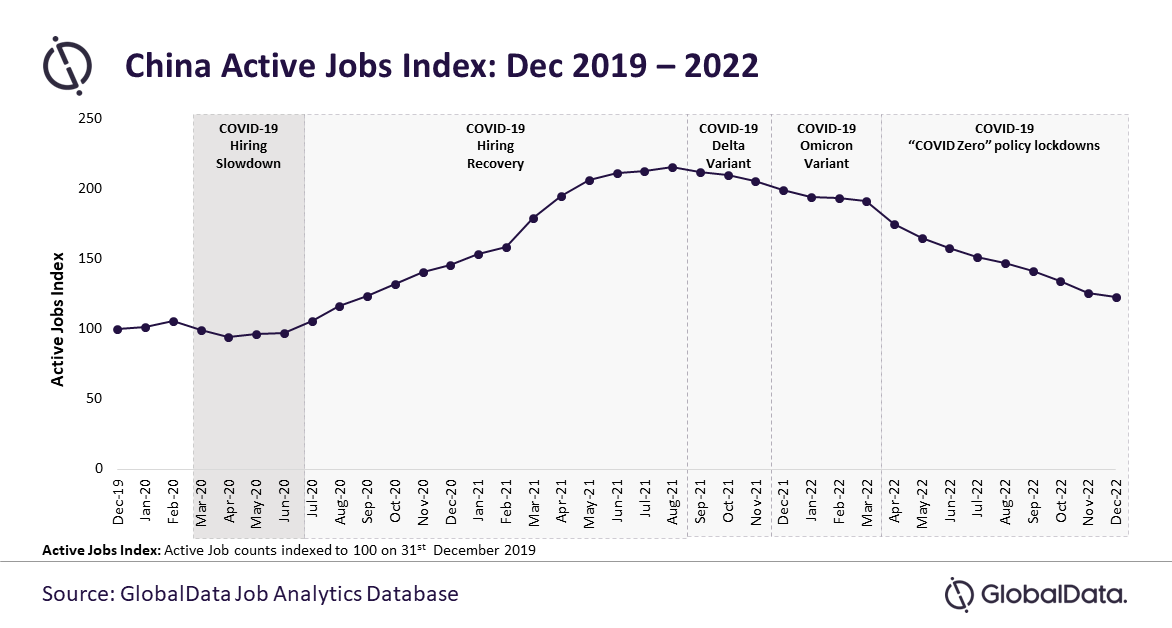
Aurojyoti Bose, Lead Analyst at GlobalData, continues: “The decline in hiring activity can be attributed to a slowdown in job postings by domestic as well as foreign companies operating in China. This trend is noteworthy as there are reports of companies exploring options to relocate from China, and domestic companies also appear to be experiencing a dent in business sentiment.”
An analysis of GlobalData’s Company Filings Analytics Database reveals that companies are discussing to reduce dependency on China and explore alternate supply chain hubs. The main issues around China were power shortage, lockdown, geopolitical tensions, tax imposition, and labor costs.
For instance, Polaris Inc is trying to create a secondary supply hub in Mexico. Similarly, BE Semiconductor Industries NV expanded its facility in Malaysia as part of its strategy to prepare itself for capacity expansions outside China. VIA Optronics AG is moving partly products from China into the Philippines.
KULR Technology Group, Inc. has moved manufacturing capabilities to Mexico from China. Woodside Energy Group Ltd is preparing floating production storage and offloading (FPSO) to move from China to Singapore. VOXX International Corporation moved to manufacture out of China to Malaysia or Taiwan, Vietnam, and Mexico.
Similarly, Key Tronic Corporation is exploring ways to move out of China, and Integrated Technologies Ltd is planning to shift manufacturing out of China and relocate to other low-cost destinations, while British American Tobacco Plc started moving production to other locations to avoid the import tariff imposed in China.
Sriprada concludes: “The current business environment suggests a shift in sentiment and a re-evaluation of the country’s attractiveness as a manufacturing and investment destination. It remains to be seen how the situation will evolve in the coming months.”