

After we published a story about my T-Mobile home Internet service dying with customer service unable to fix the problem, I got a lot of messages from readers with similar experiences. A former T-Mobile support engineer who handled home Internet support calls also reached out, claiming that the company uses canned excuses like “we’re upgrading the tower” in order to get customers off the phone and pad their stats.
Our source, who asked to remain anonymous in print but provided documentation that he had indeed worked at T-Mobile, said that he had been with the company for several years before leaving this past spring. In his most recent position, he worked in engineering, which he said is the last level of escalation for problems with the home internet service. There, he claims, he was frequently unable to solve customers’ problems but was encouraged to use an “it’s the tower” explanation so he could keep calls to under ten minutes. He said that service reps are penalized if calls run longer than 600 seconds or customers call back about the same problem within a week.
In my case, after spending several minutes on the phone with support doing everything from power cycling to removing and replacing the SIM card, I was put on hold while my rep said he would “do a few things” to fix the problem and then told that my local cell tower was being upgraded and that I shouldn’t expect to have service for 48 hours, at which point I cancelled my service. Though I was on the phone for nearly 20 minutes, it still felt like the company was trying to give me an excuse, because they couldn’t actually help me.
“In regards to the particular error code you were getting [All PDN IP Connection Failure], and the lack of response from T-Mobile as to the specifics of that error, the answer is quite simply; they don’t know,” my source told me. “I could tell you stories all day long about calls from customers with issues on their home internet service that never got solved, because no one in any of those departments, no matter how high up the chain we went, had any idea how to fix the problem.”
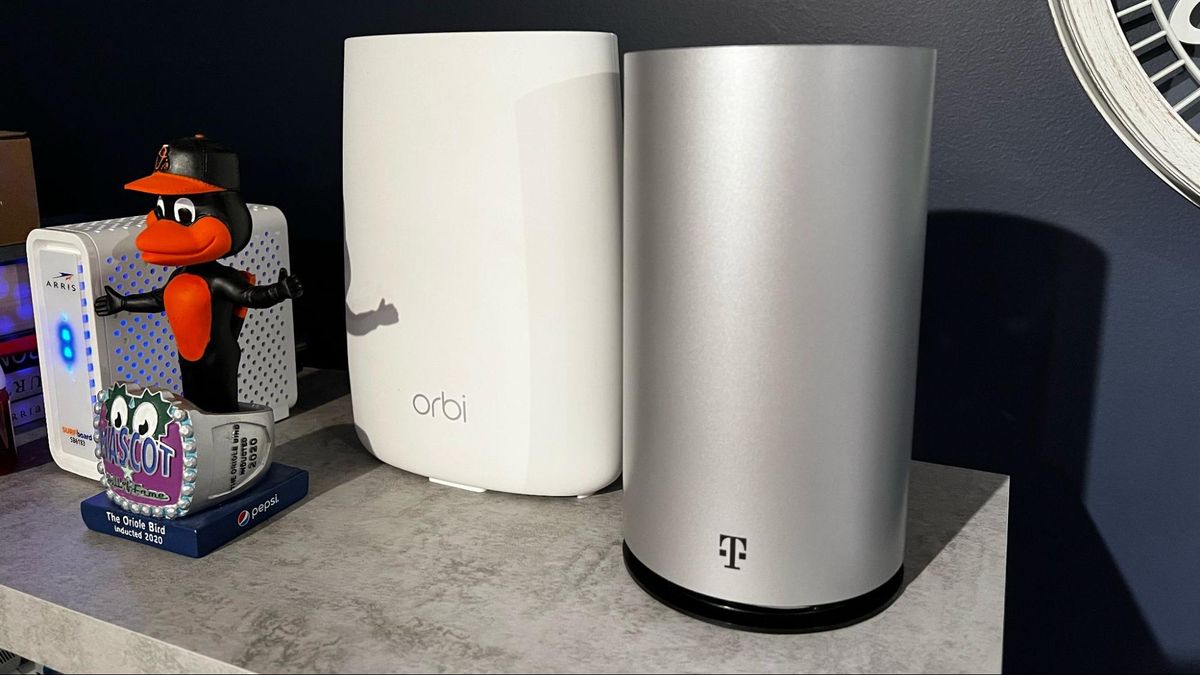
According to our source, T-Mobile customer service reps hope that a hard reset of the 5G Gateway does the trick if a customer calls in with a problem. The company will often send replacement hardware to appease customers if that doesn’t work. But as we’ve heard from customers on T-Mobile’s forums and Reddit, even this isn’t a surefire way to fix connectivity issues.
“If that doesn’t fix it, they have no clue where to go from there, and you are typically out of luck at that point,” our source explained. “The ‘tower is being upgraded’ response is a canned response that is given when they have no other answer for what is happening.”
The former employee said that, if the tower near me were really being upgraded, my rep would have told me right away. This is because customer support reps have multiple screens in front of them and can pull up a real-time map of the service area tied to your address. So if there were a tower outage or upgrade in process, the support rep would present that information to the customer within the first minute or two of the call.
Our source said that, when he worked at T-Mobile, customer service reps had a performance metric that weighed on them called First Call Resolution (FSR). If a customer called in with an issue, then called back within a week to report the same problem, the rep that the customer initially interacted with would get a ding on their performance record.
So, it was in the best interest of employees to tell customers to wait a week or more for their problems to be resolved so that they wouldn’t get hit with a negative mark by T-Mobile, he said. When I called, the customer service rep told me to wait 48 hours for the “tower upgrade” to complete, so perhaps that performance metric has changed since our source left this past spring.
Our source also told me that Call Resolution Time (CRT) is another metric by which customer service reps are measured. If they can’t get the customer off the phone within 600 seconds (10 minutes), they will also get a ding on their performance record. This encourages the reps to either get the customer off the phone as quickly as possible (sometimes by giving out false excuses about service) or kicking the problem up the chain to other departments. The last line of defense is apparently the engineering department, which is where he worked before leaving the company.
We reached out to T-Mobile for comment on our source’s accusation that the company’s support reps are under pressure to get customers off the phone (and therefore are incentivized to mislead them). However, the statement we got back didn’t really address the issue:
We frequently make improvements to our 5G network to support services like Home Internet. On some occasions, that can cause short interruptions in our service. While extended issues are uncommon and typically last less than 12 hours, we encourage Home Internet customers to reach out to our award-winning customer care team for support in these cases.
Our source attributed the issues T-Mobile Home Internet customers are encountering to a lack of foresight into the demands and rigors of relying on cellular data for home internet service.
“The company simply did not take the time to become subject matter experts in the industry, and did not properly parse out the details of potential issues they would run into, before launching headfirst into the home internet world,” he said. “They just wanted to be part of the game, and have that extra perk to offer customers, and they wanted to be able to say they were the first to offer ‘nationwide 5G Home Internet.'”
Other readers reached out to me, including Chris, who wrote about the All PDN IP Connection Failure error message I received, theorizing that the company may not have enough capacity on the newer towers which support the home Internet service.
“I was told that it has a lot to do with towers that still exist in the wild that aren’t capable of handling connections for multiple reasons. There are still Sprint towers that need to be fully integrated, and older towers that just don’t support enough connections to be reliable. All of this upgrading happens with little-to-no notice because they don’t think it’s necessary when there are towers nearby that should be a good fallback. Not so true for the home internet users!
It’s worth considering that the router connects with different parameters than would a cellphone. A cellphone crawls the network seamlessly changing from “cell” to “cell” that is covered by whichever tower. The internet service requests a connection in a bit of a different way, not expecting to be on the move but indeed expecting to use more bandwidth.
When there are multiple towers nearby and not all of them are fully compatible with the home internet service, you’re likely not going to get far enough to be assigned an IP address. If for some reason it connects to an older Sprint tower, or a tower that’s at limit for user capacity, there will be issues. Your device will ask the PDN for access and get denied. An incompatible tower may not be configured for the requests made by your device. A perfectly good T-Mobile tower may already be at capacity and so your device sits in queue hoping for a connection. It might not try indefinitely and so it becomes necessary to power cycle it.”
I asked our T-Mobile source about this possibility, and he said it could be a factor in some customers losing connectivity suddenly.
Another reader, Stanton, reached out to tell me about his problems. He was also told about tower upgrades in-process and had no trouble with T-Mobile phone service in the same location:
So I got T-Mobile home internet back during the pilot days. I’ve ran into the same errors as you. I’ve been through 5 to 6 gateways of theirs. They have claimed tower upgrade for over 6 months. My area is nothing but 5g and 5guc towers. My iPhone as well doesn’t have issues with connectivity in these areas.
I’ve been waiting over 6 months for them to resolve this issue. Eventually I told them to pause my internet so I don’t pay them for crap I’m not using. My issue is my location doesn’t have access to fancy spectrum and such. Our best landline deals are cable which wants almost 200 a month for what T-Mobile offers or AT&T which claims the fastest they can provide is 18mbps.
Gary actually had his issues solved after T-Mobile sent him a new, upgraded 5G Gateway:
I, too had complete failure of my silver CYLINDRICAL gateway. They offered me a newer version (square black gateway) and my problem went away. I am surprised they did not offer it to you. Yes, they went through the whole litany of possible causes…tower upgrade, reboots, move location of gateway, etc.. when they offered to replace the gateway with a newer version, I jumped on it. It has been working fine now for 3 months.
Interestingly, Carl contacted me to say that he signed up for T-Mobile Home Internet only to have horrible reception at his location. The company’s explanation: the service was not actually available in his area and they never should have sold it to him.
Reading your article about your T-Mobile Gateway experience brought up my own horrible experience as a First time T-Mobile cell & Home internet experience. Long story short, never worked very well at all from the beginning. Barely had 2 bars. Constantly getting tech support. Was shipped 3 additional units to ‘try’ by tech support over 90 days. Problem was, I wasn’t supposed to have been sold home internet. She confirmed my address and informed me that the “Service was NOT available in my area”. I shouldn’t have been sold the unit to begin with.
Washdc, a commenter on my prior article, wrote:
This could have been written by me… over 10 hours on the phone with customer service and their “tech team,” three different devices, 48-hour tower outage (i live about one mile away from two towers) and absolutely no consistent coverage… i will give this inconsistency a few more days, hoping that after three weeks the system “settles down” and then crawl back to fios… good bye to all the savings, hello to working internet… fios must be so proud…
To be fair, not every person we heard from has had problems with T-Mobile. Anshel Sag, an analyst who tracks 5G with Moor Strategies and Insight, said that he’s not aware of problems with T-Mobile’s home Internet service and that he uses it successfully himself.
“In my experience with the service, it operated at roughly the same speed and reliability as my smartphone,” he said
Sag said he spoke to his contacts at T-Mobile, who said that mine sounds like an isolated incident.
As the feedback I’ve gotten shows; clearly I’m not the only one who has experienced serious problems with T-Mobile Home Internet. However, it’s impossible to know what percentage of users actually had to cancel their service due to unresolved issues. Of course, people online are quicker to point out problems with a product or service than they are when they have good experiences. Those with good experiences don’t usually have a reason to speak out.
When the T-Mobile Home Internet services works, it’s fantastic. The 500+ Mbps downloads and 70+ Mbps uploads I got during my two successful weeks with the service were incredible and far superior to what my previous provider, Spectrum, was able to provide. However, the prospect of unreliable service was enough to scare me away, sending me back into the open arms of Spectrum.
However, for those that have experienced extended outages, been fed untruths by T-Mobile employees, or have been sent multiple hardware replacements in vain in hopes of solving the issues, the positive potential doesn’t matter.